United States Department of Agriculture
AgResearch Magazine


Depositing Carbon in the Bank:
|
|
|
|
Who would have thought that while industrial plants and vehicles spew greenhouse gases, thought to be causing global warming, that U.S. farms could be removing some of the excess of one of these gases, carbon dioxide (CO2), from the air?
Most of us remember at least some of it from elementary school: Plants take in carbon dioxide and use the carbon to grow. When they die, the carbon in them is returned to the soil as they decompose. Now, U.S. Department of Agriculture scientists and collaborators have developed the first national estimate of how much carbon U.S. farm and grazing land soils are currently storing: 20 million metric tons of carbon a year. This estimate shows that U.S. farm soils are indeed a net "carbon bank" or sink that keeps more carbon dioxide out of the atmosphere than they put in, overall. |
|
|
With improved management, farms and rangelands have the potential to store an additional 180 million metric tons annually, for a total of 200 million metric tons a year. This would be 12 to 14 percent of total U.S. emissions of carbon, estimated at 1.4 to 1.7 billion metric tons a year. (One metric ton equals 1.1 English tons.)
Those figures were developed for U.S. Department of State officials to use in international climate-change agreement discussions. Marlen D. Eve, a soil scientist with USDA's Agricultural Research Service (ARS) in Fort Collins, Colorado, worked with USDA's Natural Resources Conservation Service (NRCS) and Colorado State University at Fort Collins to develop the estimate of how much carbon U.S. farm and grazing land soils are currently storing. Eve had 1 year to come up with a sound estimate.
|
|
|
Estimating the Storage Potential
Eve's dilemma was how to figure out national carbon storage figures for 6 different climate regions, 6 soil types, and 22 land-use types. And he had to meet the State Department's deadline for a legally defensible way to measure the ability of U.S. farm and grazing land soils to keep carbon out of the atmosphere. Interestingly, while atmospheric carbon, in the forms of CO2 and CH4 (methane) is a component of these potential greenhouse gases, soil carbon is extremely beneficial to the environment because it is key to soil fertility and stability. This may well be the first time the State Department has been interested in the carbon cycle. The interest comes from international agreement discussions on whether countries should be allowed to offset CO2 emissions with "credits" for carbon stored in soil and trees on farms, grasslands, and in forests. These carbon credits would be traded as pollution credits currently are. In fact, some private firms, including one in the United States, are already set to trade carbon credits. Two companies have developed web sites for carbon trading. |
|
|
These companies have established values for stored carbon at about $6 a ton, but many buyers and sellers expect the price to rise quickly over the next few years. At $6 a ton, the United States could currently be storing $120 million worth of carbon annually, using Eve's figures, which are now the official U.S. figures for international discussions—with the potential to store another billion dollars' worth, based on the projections of ARS soil scientist Ronald F. Follett and others. Follett leads a soil carbon storage research team at Fort Collins. ARS scientists have long studied the carbon cycle and ways to measure soil carbon storage. But they have always done this research field by field or farm by farm, and never nationally, until now, Eve says. With not enough time to create a new database, Eve turned to existing USDA databases. Although these databases don't contain direct measurements of soil carbon, Eve used the data to derive an indirect estimate of stored carbon, based on changes in land use and farm management techniques. |
|
|
For this, NRCS's long-standing National Resources Inventory (NRI), a survey of changes in land use and farm practices done every 5 years on 800,000 fields, proved invaluable. Eve developed a computer program that uses procedures of the Intergovernmental Panel on Climate Change to calculate estimated changes in soil carbon from the NRI data. Joel Brown, the NRCS special assistant for global change at Las Cruces, New Mexico, says that agency offices at several ARS locations, including Fort Collins, worked closely with ARS to help them make the deadline.
"Follett's group had an understanding of the carbon cycle built from a decade or more's research, and we gathered the soil survey data and the NRI data that made it possible to sift out carbon information, even though it wasn't specifically measured," Brown notes. Eve's calculations yielded the first numbers consistent with the assessment of ARS soil scientist Raymond R. Allmaras, in St. Paul, Minnesota, that farm soils became a net carbon sink sometime in the past three decades. This occurred, Allmaras says, as farmers started using conservation tillage techniques, all but abandoning the moldboard plow that opened up the black prairies and started a carbon drain that lasted for almost a century.
|
|
|
Modeling's a Must
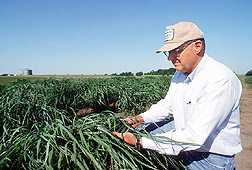
Brown says that the United States is too large to have soil carbon storage measured directly nationally, so using computer models such as CQESTR and Century is the way to produce scientifically reliable estimates. CQESTR (pronounced "sequester," after the term used synonymously with carbon storage), a new and very detailed computer model created by ARS scientists in Pendleton, Oregon, allows farmers "to determine short-term carbon gain or loss each year, based on specific management practices," says soil scientist Ronald Rickman. "Farmers can also put together sequences—such as 5 years of no-till, 1 year of conventional till, then 3 more years of no-till—to look at the consequence of changing a practice," he says. Rickman works at ARS' Columbia Plateau Conservation Research Center in Pendleton. This model lends itself to current specific, individual applications on one farm at a time, for the current season. Rickman and colleagues compared the model's predictions with observations of organic matter from 11 sites across a number of states and found it to be very accurate. CQESTR is being evaluated for national implementation and should be available in early 2001. The Century model, developed by William J. Parton at Colorado State University in collaboration with ARS, is a more general, long-term plant-soil-nutrient model that links the carbon, phosphorus, and nitrogen cycles and can be used to calculate carbon storage on grass, crop, and forest lands. The important thing about Century, Parton says, is that it gives a comprehensive simulation of carbon dynamics across an entire ecosystem over months and years so it can be used for accurate, long-term assessments of carbon storage under various practices on a regional, national, or global scale. "All of the drivers of the carbon cycle are there—temperature, precipitation, and carbon dioxide levels," says Parton. This model considers plant responses to soil nitrogen and management practices such as no-till to predict crop yields and levels of soil carbon. Many years of experience with the model give Parton confidence in its results. It has been tested on most management practices both in the United States and abroad. "The ability to use these two models in combination is great for us," says ARS soil scientist Donald C. Reicosky, in Morris, Minnesota. Timothy B. Parkin, a microbiologist at the ARS National Soil Tilth Laboratory in Ames, Iowa, measures carbon losses and gains in a much shorter time frame—in hours and days. In the lab, he has developed a system that can automatically sample CO2 emissions from 60 soil samples at a time. "This gives us the soil's potential emissions from microbes eating organic matter," Parkin says. "For the actual emissions, we go to the field, where we have automated chambers that measure carbon losses." Parkin wants to use this data to create a model that can predict short-term CO2 changes for different soils and farm practices. Parkin and ARS soil scientists at more than 25 locations across the United States are also collecting data on the factors, such as weather, that control CO2 emission rates in the field. All this information will be used to develop or improve models. Keeping CO2 Down on the Farm Reicosky, in Morris, Minnesota, has found that tillage releases carbon into the air in sudden rushes of CO2 gas that escape as soil is opened up. He has measured this with a large portable chamber placed on the soil shortly after plowing. Eve's colleagues, Ron Follett, John W. Kimble, and Rattan Lal, have calculated the potential amounts of carbon that can be stored by farms and grazing lands in this country. They determined that U.S. cropland could store an average of 142 million metric tons of carbon a year, or about 8 to 9 percent of total U.S. emissions. Private grasslands could store an additional average 70 million metric tons of carbon a year, or about 4 to 5 percent of total U.S. emissions. Follett, Kimble, and Lal have evaluated soil carbon storage for pasture and rangeland soils in a recently published book which they edited. Kimble is with NRCS and Lal is with Ohio State University. Pasture and rangelands cover large areas in the United States and globally, so they are a vital part of the carbon storage puzzle. With C.V. Cole, formerly of ARS and now with Colorado State University, the group published a similar book on carbon storage in croplands in 1998. U.S. Conservation Reserve Program (CRP) lands have been excellent storage grounds for carbon. CRP lands are highly erodible, so farmers are paid to set them aside as grass or forest lands. Follett, Kimble, and co-workers have conducted extensive field samplings throughout the U.S. Great Plains and western Corn Belt and estimate that these 36 million acres of CRP lands can store 7 to 13 million metric tons of carbon a year for the next 25 years. Eve calculates that the CRP lands currently store 10 million metric tons per year. Kenneth P. Vogel, an ARS plant geneticist at Lincoln, Nebraska, wants to turn erodible cropland into grasslands that produce biofuel crops like native prairie switchgrass grown for ethanol production or direct burning in power plants. The conversion of switchgrass to ethanol would be done using technologies being developed by ARS and the U.S. Department of Energy (DOE). "In contrast to coal or petroleum, which are stored sources of fossil carbon, biofuel crops would recycle carbon rather than add more carbon to the atmosphere," Vogel says. Vogel and Follett are measuring the amount of carbon stored in the soil when switchgrass is grown as a biofuel crop to determine if it is equivalent to that stored on CRP grasslands. They chose switchgrass because DOE identified it as a promising candidate. DOE found that one of the first areas where switchgrass can be economically grown as a biofuel crop is the Northern Plains. Vogel estimates that switchgrass could yield 500 gallons of ethanol per acre there. Vogel led the way in developing the native prairie grass into a viable renewable fuel source, beginning in 1990 with the help of a series of DOE grants. He began by evaluating his extensive collection of midwestern prairie switchgrass germplasm for yield potential and stability. "We had long studied this grass for its forage possibilities," says Vogel. "But when we started looking at its potential as a biofuel crop, we had to stress high yields far more than we did when we were looking at it as just a forage crop." ARS scientists and their university colleagues are also researching possibilities for creating other new crop varieties that either store more carbon in the soil or work better with farming methods that promote carbon storage. These methods include strip tillage and other forms of conservation tillage. Strip tillage is a compromise between two extremes—no-till and plowing. Farmers till just the part of each crop row where seeds will be planted. This is becoming an increasingly popular technique. Allmaras says that strip tillage is just one example of how American farmers have compromised to turn their land into carbon storage banks. The conservation tillage movement began in the 1970s, with a goal of having 75 percent of available cropland in conservation tillage by 2002. Great advances were made, and conservation tillage farm equipment is now mainstream. Eve calculates that conservation tillage, along with good crop rotations and fertility practices, stores 8 million metric tons of carbon a year, making it the second major contributor to carbon storage in the United States after the CRP program. But, when strictly defined as tillage methods that leave at least 30 percent of the ground covered with crop residue after harvest, farmers' adoption of conservation tillage has dropped off slightly in recent years. The reasons for this vary depending on crop and soil type and local climate. They include problems with residue harboring plant diseases or keeping soils too wet or cold to plant, leading farmers to believe that their land needs more tillage to grow crops optimally. However, as new tillage methods, such as ridge and strip tillage, are improved, farmers will be able to conserve soil, increase soil carbon, and improve productivity. Looking Ahead Regardless of what international agreements are approved, it's likely that carbon storage will find its way into new or existing programs when the next Farm Bill becomes law in 2002. Kimble thinks that this new emphasis on carbon storage could boost conservation tillage. It also seems likely that either an international agreement or domestic legislation will put limits on emissions of carbon dioxide and other greenhouse gases in this country. Critics say that soil carbon credits are just a way to get corporations off the hook for their carbon dioxide emissions. But Follett says that ARS is doing this research to buy time—up to 25 years or more—for the technologies to be developed to minimize those emissions. "We say 25 years because our estimates show it'd take that long before the soil's ability to store carbon would begin to level off, decreasing the benefits of more carbon storage," he says. Not only do soil carbon credits buy us time, but they also buy us improved soil, water, and air quality. Carbon-rich organic matter does this by reducing soil erosion while helping soil retain and break down pesticides and excess nutrients. Organic matter also contributes to agricultural productivity by providing plant nutrients and by increasing the soil's ability to hold water. In fact, soil carbon is both a priceless key to the planet's health and an agricultural commodity with a promising price tag.—By Don Comis, Hank Becker, and Kathryn Barry Stelljes, Agricultural Research Service Information Staff. This research is part of Global Change (#204) and Soil Resource Management (#202), two ARS National Programs described on the World Wide Web at http://www.nps.ars.usda.gov. To reach scientists mentioned in this story, contact Don Comis, ARS Information Staff, Beltsville, MD 20705-5130; phone (301) 504-1625, fax (301) 504-1641. |
|
"Depositing Carbon in the Bank: The Soil Bank, That Is" was published in the February 2001 issue of Agricultural Research magazine. |
|