
United States Department of Agriculture
AgResearch Magazine


Crustaceans Can Tell Us To Clean Up Our Act
|
|
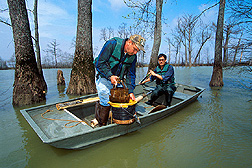 Ecologists Charlie Cooper (left) and Scott Knight sample bottom sediments in Thighman Lake for small animals that indicate ecosystem health. (K8463-3) |
The thought of tiny creatures in your water may seem disgusting, but Agricultural Research Service scientist Charles M. Cooper hopes to find a whole lot of healthy critters in his water—especially if they'reHyalella azteca.
That's because these crustaceans are a sign of good water quality. If Cooper finds healthyHyalella swimming in streams and lakes, he knows the water is clean and not exceeding critical levels of agricultural chemicals that sometimes run off from fields into water supplies. Hyalella have become a valuable tool since 1972, when the first Clean Water Act was passed. Scientists and regulators have used many approaches to measure water quality and to clean contaminated water. |
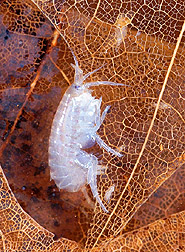 This 1/4-inch-long crustacean, Hyalella azteca, is common in aquatic systems and is used by scientists as an indicator of environmental health and water quality in streams, lakes, and other bodies of water. (K8451-1) |
But Cooper, an ecologist in the USDA-ARS Water Quality and Ecology Research Unit at Oxford, Mississippi, has turned to nature for this task—specifically toHyalella.
The 1/8- to 1/4-inch-long crustaceans are commonly found in lakes, ponds, and streams throughout North America.Hyalella consume decaying plant matter and can be found swimming in the water or burrowing into sediment. They are an important link in the aquatic food chain and a food source for several predators, including fish and various invertebrates. TinyHyalella offer many advantages as a biological indicator of environmental quality. The organisms are easy to raise, reproduce readily, and are representative of species of invertebrates found in most water systems. "They are inexpensive and easy to work with," says Cooper. The tiny crustaceans provide biological measurements of water quality so researchers don't have to rely solely on chemical and physical measurements.Hyalella are collected with other small animals common to water systems and are examined to determine whether an ecosystem is functioning properly. Scientists can then focus their research on the areas that are potentially problematic. Hyalella are also used in laboratory experiments. Cooper and ecologist Scott S. Knight expose them to various concentrations of chemicals to evaluate and model responses to actual exposures in streams and lakes. They run toxicity tests using known and controlled mixtures of multiple chemicals to determine critical levels of contamination. Then they compare their lab results to those obtained in outdoor bodies of water to determine if the lab data reflect what is happening in the real world. Monitoring water quality through chemical and physical measures reveals the effects of improved conservation farming practices. The biological method used by Cooper, however, confirms whether these practices are improving the overall health of the ecosystem. In the end, results are used to make recommendations to farmers to promote a healthy, clean environment.—BySarah Tarshis, formerly with ARS. This research is part of Water Quality and Management, an ARS National Program (#201) described on the World Wide Web at http://www.nps.ars.usda.gov/programs/nrsas.htm. Charles M. Cooper and Scott S. Knight are in the USDA-ARS Water Quality and Ecology Research Unit, P.O. Box 1157, Oxford, MS 38655-1157; phone (662) 232-2935, fax (662) 232-2915. |
|
"Crustaceans Can Tell Us To Clean Up Our Act" was published in the February 2000 issue of Agricultural Research magazine.
|
|
