
United States Department of Agriculture
AgResearch Magazine


Sunshine Bass Makes a Splash!
|
|
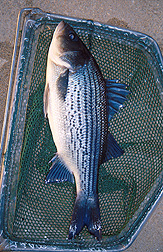 Sunshine bass. (K8749-1) |
In the early 1980s, East Coast fishermen peddled striped bass to fish markets, netting up to 14.7 million pounds annually. Eventually, however, overfishing and pollution essentially destroyed the industry. Fish farmers of the East Coast, Arkansas, and California thought the fish could make a comeback in aquaculture ponds and fill a market vacuum. Thanks partly to research, they were right. Since 1984, when production was at only 10,000 pounds a year, it has increased to more than 15 million pounds annually. Actually, it's a hybrid fish called sunshine bass that's making the splash. A cross between male striped bass and female white bass, sunshine bass grow faster than either parent. Fish farmers Mike Freeze of Keo, Arkansas, and Jackson Currie of Wilmot, Arkansas, are among the leaders in the sunshine bass industry. Freeze specializes in spawning the parental stocks. He and Currie then nurture the just-hatched fry from the time they are barely visible—2 to 5 millimeters long—until about 35 days later when they're 3/4- to 1-inch-long fingerlings. They then sell the juvenile fish to other farmers around the world who grow them to market size at 1.5 to 2 pounds in 18 months. |
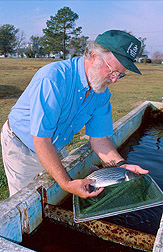 At the ARS National Aquaculture Research Center in Stuttgart, Arkansas, fish biologist Gerald Ludwig examines a market-size sunshine bass. (K8749-2) |
To identify production problems and find solutions, Gerald M. Ludwig, a fish biologist at ARS' National Aquaculture Research Center at Stuttgart, Arkansas, keeps in contact with Freeze, Currie, and other producers. "We learn as we bounce ideas off each other," says Currie. In the early 1980s, after experimenting with raising microscopic animals called rotifers as fish feed, Currie turned some equipment over to Ludwig. Putting the equipment to good use, Ludwig steadily found ways to improve the survival rate of young fish. "Until a few years ago, we could achieve only a 10-percent survival rate of fry," said Ludwig. "Now the norm is 30 percent, and some nursery pond managers do much better." Ludwig and his colleagues developed information to help fry culturists time the stocking of ponds so the fish can eat and grow fast enough to avoid being eaten by zooplankton—some of the very creatures they must consume to survive. Graphs and equations Ludwig developed show the pivotal window of opportunity when two other essential food sources, rotifers and minute crustaceans called copepod nauplii, become abundant and zooplankton are still too small to be a threat. The equations take into account pond temperature, which strongly influences the buildup of rotifers, and rainfall, which helps drive the growth of the copepod nauplii. Other influences that help determine the proper stocking time include day length, dissolved oxygen levels, and air temperature. The research may improve the culture of additional tasty fish species like yellow perch and walleye. If technology affords consumers year-round choices from among several cultured species, steady buying habits may develop. Then fish farmers may not have their resources lying idle much of the year. Ludwig and his colleagues are also researching ways to manage fish so they'll spawn all year long. That means they need to develop the know-how for providing a year's supply of live, appropriately sized zooplankton. Ludwig's plan also calls for growing rotifers and copepod nauplii in ponds or indoor tanks and redesigning a device called a rotating drum filter to harvest them. Larger zooplankton will be freeze-dried for enriching diets as the fry grow into large fingerlings ready to be moved into production tanks.—By Ben Hardin, Agricultural Research Service Information Staff. This research is part of Aquaculture, an ARS National Program (#106) described on the World Wide Web at http://www.nps.ars.usda.gov/programs/appvs.htm.Gerald M. Ludwig is at the Harry K. Dupree Stuttgart National Aquaculture Research Center, USDA-ARS National Aquaculture Research Center, 2955 Hwy. 130 E., Stuttgart, AR 72160; phone (870) 673-4483, fax (870) 673-7710. |
|
"Sunshine Bass Makes a Splash!" was published in the February 2000 issue of Agricultural Research magazine. |
|
