
United States Department of Agriculture
AgResearch Magazine


Onward From Mendel
|
|
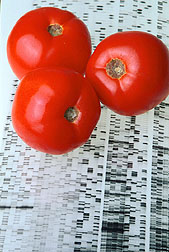
If Gregor Mendel could see us now! Surely he'd be delighted that his own discoveries about the inheritance of traits—stemming from his experiments in the mid-1800s with garden peas—have become a foundation for modern genetics.
Perhaps he'd be impressed that, within the first year of the new millennium, ARS scientists and their colleagues worldwide expect to finish the first complete map of the genes of a green plant—a mustard called Arabidopsis thaliana, or thale cress.
Granted, we selected this plant because of its relatively tiny genome. But what we learn about the genes that control this plant's life—from germination to fruiting—will help us discover the function of other genes in thousands of plants—and other organisms.
We're also mapping genomes of rice, wheat, cotton, soybeans, corn, sugarbeets, potatoes, tomatoes, and other crops. And we're not just delineating existing genetic landscapes. We're moving useful genes from one species to another to improve a food crop's adaptability, flavor, nutritional value, or insect or disease resistance—or to dramatically improve in other ways the plants we rely on for food, feed, or fiber or value for their beauty.
The new and burgeoning field of bioinformatics—also known as computational biology—is bringing together genetics, computer science, and mathematics to answer questions about gene location, structure, and function. By harnessing the computer's analytical power, we're searching for similarities in genes of different organisms. We'd bet Mendel would well understand how such similarities could speed the discovery of genes that control prized traits.
With a dozen new automated DNA analyzers, we hope to reveal gene sequences in days instead of weeks, months, or years.
We'd tell Mendel how we help run the publicly accessible computer catalogs of plant genes. He could "surf the web" to the GrainGenes database—a treasury of genes of wheat, barley, and other grains. Or SolGenes, the world's most comprehensive genome database for solanaceous crops like tomatoes, peppers, and potatoes.
Once he'd had a chance to take this all in, we would expect—would hope for—some suggestions. Objective scrutiny, after all, is essential to the scientific investigations of every era.
Though fun to imagine, Mendel of course cannot visit our labs, given that he died in 1884. It wasn't until the first year of a new century—1900—that his discoveries of the natural laws of heredity began to become generally known. But today, 100 years later, the determination, dedication, and sense of wonder that characterized Mendel and other early geneticists are still alive and well in ARS laboratories.—By Marcia Wood, Agricultural Research Service Information Staff.
This research is part of Plant, Microbial, and Insect Genetic Resources, Genomics, and Genetic Improvement, an ARS National Program (#301) described on the World Wide Web at http://www.nps.ars.usda.gov/programs/cppvs.htm.
For details on ARS plant genomics projects, contact Peter K. Bretting, National Program Leader for Plant Germplasm, USDA-ARS National Program Staff, 5601 Sunnyside Ave., Beltsville, MD 20705-5139; phone (301) 504-5541, fax (301) 504-4663.
"Onward From Mendel" was published in the December 1999 issue of Agricultural Research magazine.
