
United States Department of Agriculture
AgResearch Magazine


Animal Agriculture—Conception to Consumption
|
|
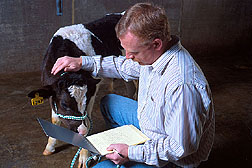
Back in 1899, when America last prepared to greet a new century, the big news in animal health circles was a vaccine: the blackleg vaccine, a critical tool against a devastating cattle disease that sometimes claimed as much as a third of infected herds. That year, USDA's Bureau of Animal Industry reported that a significant portion of BAI pathologists' time was spent in simply trying to get the vaccine distributed to anxious stock owners across the country.
A century later, the Agricultural Research Service, heir to the animal health work of the old Bureau of Animal Industry, is still concerned with keeping the nation's flocks and herds healthy. But today's vaccines are beyond the wildest dreams of the BAI pathologists of a century ago, because today's vaccines—like today's livestock—are emerging with increasing frequency from the cutting edge of high technology.
Genomics has become the name of the game, not only in producing vaccines to protect our animals, but also in producing animals that are inherently more healthy. And the Agricultural Research Service, formed by USDA in 1953, is a key player with multidisciplinary programs that embrace both animal and plant sciences. ARS scientists and administrators recognize and seek to understand the complex relationship between animal health, production, processing, and food safety—as one observer has noted, "everything from conception to consumption."
With supermarket meat counters bulging with every conceivable dairy and meat product—and some that citizens of a century ago would not recognize, such as turkey ham, for example—it might look to the uninformed observer as though all our animal health problems must surely be solved by now, judging simply from supply.
But that would be wrong. The battle of animal health is as heated as ever, and—even beyond the obvious issue of supply—victory in that battle is critical to every American.
The reason: Production of foods derived from animals has a sizeable impact on the U.S. economy. The value of livestock, poultry, and other animal products, including wool and milk, for 1999 has been estimated at $96 billion, according to the Economic Research Service. That's why in 1999, ARS budgeted $127 million for animal research programs; for the year 2000, that budget is projected at $130 million. These research dollars will be an investment to protect and sustain a significant part of the U.S. economy. Strides in Animal Health
The biggest single hindrance to reaping the full benefits of the United States' booming animal production system is animal disease. Diseases that debilitate and kill animals can take a huge bite out of livestock producers' revenues. Economic losses to diseases of livestock and poultry have been estimated to be 17 percent of production costs in the developed world and more than 34 percent in the developing world. Diseases limit the ability of animals to produce optimum levels of meat, milk, and fiber.
The first step in controlling or eliminating disease is to diagnose it. In years gone by, scientists dreamed of producing a good diagnostic test that would give them—and producers—an early alert to disease problems. Today's cutting-edge technology is making that possible. Researchers can now pinpoint a gene—or, in some cases, a region on the chromosome of a disease-causing virus or bacterium—that can be isolated and used in probes or tests to detect the presence of that disease in an animal long before it shows any signs of illness.
Just such a gene-based test was developed by ARS scientists at the National Animal Disease Center (NADC) at Ames, Iowa, to detect Johne's disease, a bacterial infection that can lead to severe diarrhea and death. With a price tag to producers of more than $1.5 billion annually, Johne's is currently one of the most costly diseases facing the dairy cattle industry.
|
|
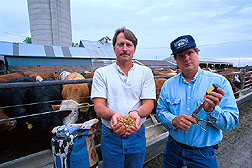
ARS microbiologist Judith H. Stabel cloned a specific gene for Mycobacterium paratuberculosis, the organism causing Johne's. Then Stabel and other researchers used that cloned gene in a test to unmask the Johne's organism in blood or other tissue. These types of early-warning diagnostic tests allow veterinarians and producers to take action during the early stages of infection, when infected animals may appear normal and healthy but could already be spreading the disease to their herdmates. Such diagnostic tests and high-tech vaccines translate into billions of dollars in savings for America's livestock producers. For example, in the 1960s, hog cholera cost animal producers more than $100 million a year. But a fluorescent antibody test developed by ARS researchers at NADC helped eradicate the disease from the United States by 1978.
More recently, ARS announced development of an oral vaccine against shipping fever of cattle. The new vaccine, a true child of high tech, was created by deleting a large piece of a gene called aroA from each of three culprit bacteria: Pasteurella haemolytica, P. multocida, and Haemophilus somnus. Without this gene, the bacteria do not cause infection. The new vaccine, which could be commercially available in as little as 3 years, may help U.S. cattle producers cut shipping fever losses that now total more than $1 billion annually.
High tech has come to the aid of the poultry producer as well. For example, ARS researchers at Athens, Georgia, and College Station, Texas, have used the latest in biotechnology to develop innovative ways to prevent Salmonella bacteria from gaining a foothold in the intestines of chickens.
The Athens-based researchers developed a mucosal bacterial culture to prevent the growth of Salmonella in newborn chicks. At College Station, scientists were able to separate from the multitude of bacteria in a mature chicken's gut those bacteria that specifically play a role in naturally protecting the adult chicken against Salmonella colonization. The protective bacteria were then produced en masse for use in a product now on the market as PREEMPT, a blend of 29 organisms that can be sprayed over newly hatched chicks to keep Salmonella from settling in their intestines.
In years past, researchers patiently learned the techniques needed to obtain and transfer embryos in cattle and to control the sex ratio and number of offspring. At Clay Center, Nebraska, ARS researchers learned how to form genetic composites by crossing animal breeds. This allowed them to select for specific traits linked to economic importance.
"Our advances in gene marker selection will allow 21st century researchers to develop breeds of animals to meet specific market needs," says Dan B. Laster, director of the agency's U.S. Meat Animal Research Center at Clay Center. In future years, advances in knowledge of animal genetics will allow researchers to select the genes that impart resistance to disease as well as quality characteristics such as size, reproductive capability, or leanness.
One promising development came in the mid-1990s, when ARS researcher Melissa Ashwell at Beltsville, Maryland, discovered that a specific site on chromosome 23 in Holstein dairy cows may hold a vital clue to whether a particular cow is more prone to mastitis infection. Mastitis is a bacterial infection of dairy cows that costs U.S. farmers more than $2 billion annually for treatment and lost milk production.
Ashwell was involved in studies of the DNA of grandsires from seven different families of Holstein cattle, noting any genetic differences at three locations on each chromosome of the bulls. She and colleagues discovered that the lineup of genes at a specific site on chromosome 23 differed between bulls whose daughters' milk contained high numbers of somatic cells—indicating a greater rate of mastitis—and bulls whose female offspring had lower somatic cell scores.
"For cattle and pigs, knowledge about specific genes for reproduction and disease resistance is still in its infancy," says Steve Kappes, ARS national program leader for animal production. But ARS researchers are working with others in the scientific community to break the code of the animal genome and identify the specific gene or genes that may play a role in disease resistance and production traits. These valuable accomplishments will help shape technologies in the next 30 years.
Safety of Animal-Based Foods
|
|
At the other end of the conception-to-consumption continuum, ARS scientists have played an important part in developing new methods to help ensure the food we eat is safe. For example, Donald W. Thayer, an ARS research chemist in Wyndmoor, Pennsylvania, was the first scientist to discover that irradiation could control the meat-contaminating pathogen E. coli O157:H7.
Thayer successfully used irradiation against several other foodborne pathogens, including Bacillus cereus, Clostridium botulinum, Listeria monocytogenes, Salmonella, Staphylococcus aureus, and Toxoplasma gondii on meat and poultry. Thayer's research influenced the Food and Drug Administration's approval of the use of irradiation on poultry in 1990 and on red meat in 1997.
At the processing plant, more automation will increase production efficiency and food safety. "In poultry processing, machines and robots will help minimize cross contamination of carcasses. That means safer products with remarkably less Salmonella and Campylobacter," says Mike Robach, vice president of quality assurance and regulatory affairs for Continental Grain Company.
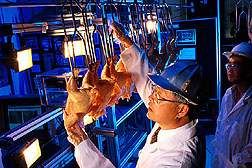
One processing advance of the type predicted by Robach is the automated chicken inspection system developed by ARS researcher Yud-Ren Chen at Beltsville, Maryland. As chickens come down the line at a processing plant, the system "sees" them with a visible- and near-infrared light probe and four cameras fitted with filters. The light probe sends reflected light to a spectrophotometer linked to a computer. The computer analyzes the data to spot both surface and internal color and tissue composition changes that indicate reasons for rejecting the carcass, such as blood-related diseases, bruises, or tumors.
The system is capable of scanning chickens at line speeds up to 140 birds a minute, using a red light to signal to a human inspector that a particular bird warrants a closer look. The system was tested in a commercial poultry processing plant in Pennsylvania in the spring of 1998 and is now undergoing refinements to make it sturdier and more durable in the humid environment of chicken processing plants.
High technology is now a crucial and permanent partner in ARS animal research—whether the task at hand is creating a better vaccine, a naturally healthier animal, or safer meat and dairy products for American consumers.—By Linda McGraw, Agricultural Research Service Information Staff.
To learn more about ARS' vision for Animal Health and Production, see the agency's World Wide Web page at http://www.nps.ars.usda.gov/programs/appvs.htm.
Contact scientists mentioned in this article through Linda McGraw, USDA-ARS National Center for Agricultural Utilization Research, Information Staff, 1815 N. University St., Peoria, IL 61604; phone (309) 681-6530, fax (309) 681-6690.
"Animal Agriculture—Conception to Consumption" was published in the December 1999 issue of Agricultural Research magazine.
