
United States Department of Agriculture
AgResearch Magazine


Faster, Better Food Analysis
|
|
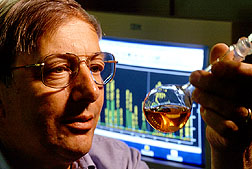
Amid the rolling terrain of the Beltsville (Maryland) Agricultural Research Center, where Agricultural Research Service scientists work to build better food crops and animals, sits the Food Composition Laboratory (FCL) building. There, chemists take food apart--molecule by molecule. They work to develop and refine methods that will allow other chemists to measure the nutrients and contaminants among the thousands of compounds in foods.
"We're in the business of describing the components in American foods," says James M. Harnly, who is head of the lab. "Many times, the analytical methods for specific components are lacking or inaccurate. We adapt existing technology or develop new technology based on needs."
FCL's customers include commodity groups, commercial analytical laboratories, instrument companies, AOAC International (formerly the Association of Official Analytical Chemists), and several federal agencies, as well as other USDA laboratories and agencies. Ultimately, the work of FCL chemists sharpens and adds to the values in USDA's national nutrient database. Maintained by ARS' Nutrient Data Laboratory in Riverdale, Maryland, the database is the foundation for all U.S. food composition data.
Nancy J. Miller-Ihli recently responded to one FCL customer by producing a far more sensitive graphite furnace method for detecting lead in sugar and sweeteners. It can be used with a wide range of commercial atomic absorption spectrometers, she says.
The Food Chemicals Codex (FCC) committee, which is under the National Academy of Sciences' Food and Nutrition Board, wanted to lower the acceptable limits of lead in sugar and corn syrup because of the large amounts consumed, says Miller-Ihli.
|
|
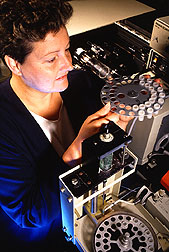
But there's no sense in lowering the limits from 500 parts per billion to 100 ppb if analytical methods can't detect 100 nanograms (billionths of a gram) of lead in 1 gram of sugar. So they approached Miller-Ihli for help in developing a sufficiently sensitive method.
The acid-digestion method Miller-Ihli developed with the help of chemist Ella Greene is even more sensitive than was called for: It can detect just 10 ppb. Both FCC and the International Commission on Uniform Methods for Sugar Analysis have adopted it as their official method. Not only is this a much easier, direct method that's 10 times more sensitive than the official method, "It saves time and avoids potential sample contamination," says Greene.
The atomic absorption spectrometer with graphite furnace atomization is one of the most sensitive instruments for identifying and measuring elements. But it has one drawback: It traditionally measures only one element at a time. As the research community became interested in more than a few trace elements, Harnly and co-workers developed technology to measure 16 elements simultaneously.
In the meantime, other technology has come on the market that can analyze multiple elements simultaneously and is as sensitive as atomic absorption spectroscopy. However, these other instruments are currently much more costly, says Harnly. He hopes a small venture company will turn this research into a marketable alternative.
Harnly and Miller-Ihli are two of six research chemists in FCL who oversee individual projects. The research chemists are supported by four chemists with temporary appointments and five support chemists.
In developing methods, Harnly notes, "we have to take into account that a food compound can have many forms. Some are more biologically active than others. If you want to have a definitive method, you need to know how the body uses the different forms." That's why FCL chemists are working to distinguish among the different forms of the vitamins folate and niacin and of the trace elements iron, cobalt, and selenium.
With help from chemist Gary R. Beecher, chemist Robert F. Doherty is developing a chemical method to distinguish between the three or four major forms of folate, including folic acid, which is now used to fortify grain products. Laboratories currently use a microbiological assay to measure total folate, says Beecher. "Our concern is to get values for individual folates for the USDA food composition database using modern instrumentation."
For commercial laboratories, the new method must be simple and straightforward and use equipment that is commercially available. Doherty and Beecher should have a chemical analysis for the folate forms ready in about a year.
Finding the Phytonutrients
FCL is in the forefront of the emerging field of phytonutrients, thanks in part to its collaboration with the National Cancer Institute (NCI) and the National Heart, Lung, and Blood Institute (NHLBI). Scientists worldwide are searching for the active plant compounds--or phytonutrients--that are behind the lower incidence of cancer and cardiovascular disease in populations that eat plenty of fruits, vegetables, and other plant foods.
Abby Ershow, nutrition program officer for NHLBI, says her agency has supported FCL's research since its beginning in the 1970s, because sound dietary advice rests on good analytical methods.
|
|
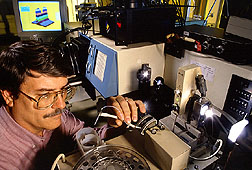
"For example," Ershow asks, "should women going through menopause eat soybean products every day? Can soy products serve as replacers for synthetic estrogen? Nobody is quite sure yet," she says, "because there are different forms of phytoestrogens in different foods. Until you have the methods to take the foods apart and link the shape of that molecule to the biological effect, you can't give good guidance. The FCL chemists are right in the middle of that issue."
Earlier this decade, the National Cancer Institute wanted to know more about carotenoids in the diet. Evidence was mounting that these red, orange, and yellow pigments--such as beta carotene and lycopene--were protective. Under Beecher's direction, FCL chemists sorted through more than 40 carotenoids in foods.
They found that only about a half dozen are consumed in significant amounts and absorbed by the body and, thus, are biologically important. [See "Plant Pigments Paint a Rainbow of Antioxidants," Agricultural Research, November 1996, pp.4-6, and "Data You Can Trust," May 1995, p.15.] As a result of the FCL research, the Nutrient Data Laboratory (NDL) published a table of the five prominent carotenoids in commonly eaten foods.
Beecher then turned his attention to a loose-knit family of compounds--the flavonoids--some of which reportedly reduce risk of cardiovascular disease and cancer. Among the thousands of flavonoids in nature, Beecher suspects about 20 to 25 are common in frequently consumed fruits, vegetables, and other plant foods. Chemist Howard Merken came on board last spring to develop a single method to measure the prominent flavonoids in a range of foods.
"We decided which were important from scattered data from horticultural science, as well as from diet and health data from other countries," Beecher says, noting that a primary criterion was the compound's antioxidant activity. "Whether that's the protective activity, we don't know."
Reading Tea Leaves
Oddly enough, the first foray of these analytical minds into flavonoid chemistry was in reading tea leaves. Beecher and chemist William Bronner measured catechins in different types of tea. The most consumed beverage worldwide, tea is the only food product known to contain significant levels of these potent antioxidant flavonoids.
Analyses showed "there's a huge difference in catechin content among black teas in the bag," says Beecher. Instant (powdered) tea mixes have little or no catechins. Bottled teas and herbal teas lack them entirely.
Beecher's group is now examining two types of estrogen-mimicking compounds. The best known are isoflavones from soy products like tofu, tempeh, and soy concentrates and isolates added to many foods. A less studied group, the lignans, come from flax, rye, and some nuts and beans.
The chemists are generating data for a table of isoflavone values being compiled by the NDL. Beecher says the analytical methodology for isoflavones had already been worked out by Patricia Murphy at Iowa State University. "But we analytical chemists are way behind on methodology for lignans."
Beecher is also working with Myron Gross at the University of Minnesota to study how specific flavonoids affect early indicators of cardiovascular disease. The indicators include blood clotting and oxidation of LDL cholesterol--the artery-clogging form.
"Gary is providing a detailed characterization of the foods and flavonoid-containing food extracts we use in feeding studies," says Gross. "He probably knows more about food flavonoids than anyone in the country."
Food's Gold
Less than one-half ounce of the "typical American diet"--homogenized, freeze dried, and characterized for the major nutrients and 31 trace elements--sells for only $445. And that's a bargain.
The cost of preparing and analyzing Standard Reference Material (SRM) 1548a (Typical Diet) was $198,000, says Jennifer Colbert, project manager for SRMs at the National Institutes of Standards and Technology. She says the price of an SRM depends on the total cost of materials and labor divided by the number of units.
SRMs are the "gold standard" of analytical chemistry, says Wayne R. Wolf of the ARS Food Composition Laboratory (FCL) at Beltsville, Maryland. Chemists use these certified materials to validate new or improved analytical methods and to establish values for less expensive reference materials used in day-to-day quality control in the food industry.
SRMs with a chemical makeup similar to the foods being analyzed are so important to research that Wolf has taken a lead in coordinating their development. In 1993, he founded a technical division of the AOAC International to help make reference materials more available. That includes identifying the nutrients that need to be certified and the range of foods necessary to represent the entire U.S. food supply. "He knows where the standards are needed," says Colbert.
Wolf helped launch an SRM made of infant formula. "There were no food-based materials for vitamins when we started putting this together," he says. With a price tag of $216 for ten 30-gram packets, SRM 1846 (Infant Formula) has values for 12 minerals and 17 vitamins. Since it also contains folate values, it can be used by millers and bakers--who are now required by law to fortify most grain products with the vitamin--to ensure adequate folate enrichment of their products.
Ultimately, says Wolf, the accuracy of food labels and nutrient data rests on food-based SRMs.--By Judy McBride, Agricultural Research Service Information Staff.
James M. Harnly, Nancy J. Miller-Ihli, Gary R. Beecherand Wayne R. Wolf are at the USDA-ARS Food Composition Laboratory, Bldg. 161, 10300 Baltimore Ave., Beltsville, MD 20705-2350; phone (301) 504-8356, fax (301) 504-8314.
"Faster, Better Food Analysis" was published in the December 1998 issue of Agricultural Research magazine.
