
United States Department of Agriculture
AgResearch Magazine


Imported Wasps Work Well as Biological Controls
|
|
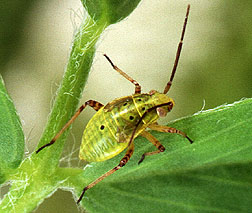
Three major pests of alfalfa and other crops may soon be on the run from a pair of parasitic wasps from Europe.
The wasps are cousins: Peristenus digoneutis and P. conradi. Their targets: three plant bugs.
The alfalfa plant bug, Adelphocoris lineolatus Goeze; tarnished plant bug, Lygus lineolaris Palisot; and lygus bug, L. hesperus Knight, are important pests of crops grown for seed in the western United States. Each year, they cause tens of millions of dollars in losses and control costs. They suck the sap from flowers, young fruits, and seeds. The alfalfa plant bug is an immigrant pest, but the two Lygus species are native to North America.
Vegetable and fruit seed crops suffer similar losses from the two Lygus species, says entomologist William H. Day, who is with the Agricultural Research Service. "Nymphs and adults of each species attack the plants, and native parasites can't adequately suppress any of them."
Although all three plant bugs occasionally reach high levels in the 24 million acres of alfalfa grown for forage, they usually do little damage to this crop grown in the 48 contiguous states.
However, the two Lygus species pose a special problem: When alfalfa is cut for hay, they fly off to infest and damage fruit and vegetable crops such as strawberries, peaches, apples, and beans growing nearby.
Estimating plant-bug damage is difficult. "Visible injury by sucking insects like these plant bugs is often confused with other causes or overlooked," Day says. "Furthermore, their feeding on crops grown for seed can both lower yields and reduce germination of seed that does survive."
Day and three other ARS entomologists conduct laboratory and field tests on parasites and predators of problem insects at ARS' Beneficial Insects Research Laboratory in Newark, Delaware. The lab's mission is to import beneficial insects into the United States for establishment in areas where insect pests—especially those of foreign origin—are abundant.
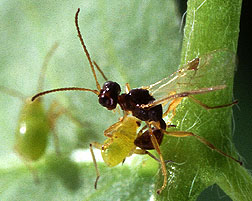
Day's current interest is wasps, especially P. digoneutis, a quarter-inch-long parasite of the two native Lygus plant bugs, and P. conradi, which attacks the alfalfa plant bug.
"A female Peristenus wasp stings a young plant bug nymph, laying a tiny egg in it," he says. "A few days later, a wasp larva hatches and begins to eat the nymph."
According to Day, "Using biological controls is better than chemicals for controlling pests in northeastern alfalfa. Chemical insecticides add to crop production costs and sometimes cause environmental problems. They can also kill parasites previously established by our lab that now control three other pests of alfalfa—the alfalfa weevil, pea aphid, and alfalfa blotch leafminer."
Beginning about 1978, entomologists at ARS' European Biological Control Laboratory, now located in Montpellier, France, collected Peristenus wasps in Europe and shipped them to Day in Delaware. Day released them from 1979 to 1983 in northern New Jersey and determined that they were successfully established there in 1984.
He also led an interagency team to track where the parasites have become established and spread. Its members included Day and ARS biological technician Joseph M. Tropp, along with Robert J. Chianese of the New Jersey Department of Agriculture, Trenton; Ronald F. Romig of West Chester State University, West Chester, Pennsylvania; Roy G. Van Driesche of the University of Massachusetts, Amherst; and Allen T. Eaton of the University of New Hampshire, Durham.
The team surveyed several hundred fields, collecting samples of plant bugs from which parasites were later reared for identification.
|
|
Day found that P. digoneutis had spread into New York by 1989. Since then, the team has found this parasite in five new states (Pennsylvania, Massachusetts, New Hampshire, Vermont, and Connecticut) and in a total of 36 counties—over 45,000 square miles.
"The probable range is likely larger," Day says. "We detected P. digoneutis in 12 new counties we surveyed in 1995 and in 11 additional counties in 1996."
Most of its dispersion has been to the Northeast, he says. That's largely because the wasps travel with the prevailing summer winds from the Southwest. Plus, they apparently can't cope with the warmer climate to the south of New York City.
"The parasite has only moved about 30 miles south in 12 years," notes Day, though genetic selection may eventually allow it to move farther south. But in the near future, its control of tarnished plant bugs will likely be limited to the northern United States and southern Canada, he says.
As for P. conradi, Day first discovered it had become established and was attacking the alfalfa plant bug in 1988. P. conradi has spread less extensively than P. digoneutis, partly because it reproduces only once a year, while P. digoneutis breeds twice.
"P. conradi has spread into New York from its initial establishment points in northern Delaware and central New Jersey. Joe and I found it in 9 counties, but it's probably present in others," says Day, "because our surveys for this parasite have been limited."
When Day and Tropp sampled northeastern alfalfa grass fields for P. digoneutis and P. conradi wasps, they commonly found seven species of plant bugs and three native wasp parasites. The latter were ineffective controls for both the tarnished and alfalfa plant bugs, prompting the overseas search for new parasite species.
They Know What They Like
Day says, "Our host range data also show that the two introduced parasites significantly attack only the target pests, so they are unlikely to reduce nontarget or nonpest species. That's good news for biocontrol efforts and ensures that ecological balances are not disturbed."
|
|
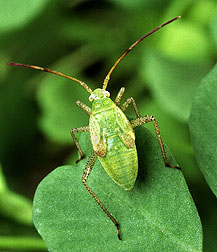
Day's research turned up something unusual. He has long suspected that the tarnished plant bug, a native U.S. insect, could be controlled by a foreign parasite. Traditionally, researchers turn to a foreign biocontrol to control a foreign pest.
"But our experience with P. digoneutis indicates that certain foreign biocontrol agents have untapped potential to go after some of our troublesome native insect pests," he says.
Day believes that although introduced beneficials are carefully screened before they are imported and released, to ensure they will not attack native beneficial insects, "there has been insufficient research to determine if foreign biocontrol insects might control some native insect pests."
Day's research on the wasps' dispersion and geographic limits provides information needed to establish them in other regions of the United States.
"With what we now know about the spread and effectiveness of P. digoneutis, it appears that it has the potential to control the two Lygus bugs on alfalfa forage and seed crops over wide areas of the northern United States," says Day.
Research now under way at several locations will determine if these classical biological control results can be repeated on seed alfalfa in the Northwest and on strawberries and other fruits and vegetables in the Northeast. — By Hank Becker
William H. Day is at the USDA-ARS Beneficial Insects Research Laboratory, 501 South Chapel St., Newark, DE 19713; phone (302) 731-7330 ext. 224
