
United States Department of Agriculture
AgResearch Magazine


T-Cell Testing Made Easy
|
|
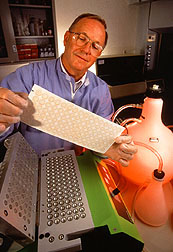
The need for a quick and easy way to test people's immune competence first hit Tim Kramer in 1976 while working at the Anemia and Malnutrition Research Center in Chiang Mai in northwest Thailand.
Kramer was returning a previously malnourished child to her home some 4 hours' drive from the center, over very hilly terrain. As he passed through the small villages along the way, he thought, "I'd love to have some data on how malnutrition affects cellular immunity in such a location."
In layman's terms, that's the ability of T-cells to rapidly divide when they bump into a chemical stimulus, or antigen. Among the immune cells, Kramer explains, T-cells are the most sensitive indicators of a person's nutritional status, because their activity is altered by even marginal nutritional deficiencies.
But it would have been very difficult technically to do such measurements in a makeshift laboratory in the countryside, says Kramer. The traditional method requires at least 10 milliliters of blood. Many people in Thailand and other Asian cultures are opposed to giving blood. Assuming one could get enough, the T-cells then would have to be separated by highly trained technicians using expensive equipment before they could be cultured and subjected to a foreign substance to prompt them to divide.
As a solution, Kramer thought, "Why couldn't we use a microculture of whole blood instead of separating the lymphocytes [T-cells and related cells]." Such a technique would require only a few drops of blood and significantly reduce the technical requirements . . . and thus the cost.
But it took 11 years and Agricultural Research Service (ARS) backing before Kramer had the time and resources to begin developing the whole-blood culture technique. "And it's so simple, it's ridiculous," he says. Kramer is a nutritional immunologist at ARS' Beltsville (Maryland) Human Nutrition Research Center.
Refined, Over Time
For the last decade, Kramer has tweaked the technique into a foolproof measure of cellular immune competence for nutritional studies—particularly for use in field studies of large populations. During that period, a handful of other immunologists began developing the technique for other types of research and clinical use.
"But it's still not widely accepted among immunologists," says Kramer.
He hopes the situation will change after publication of his method by the National Academy of Sciences. Because of its simplicity and reduced cost, it could be used routinely to screen infants and children, the elderly, and others whose immune competence may be suspect.
"The technique is ideal for pediatric use," says Kramer, since it requires only 0.4 milliliter of blood or less—just a few drops. "That's one-twenty-fifth the amount needed for the traditional method."
And it costs 35 to 40 percent less because it doesn't require a microscope or centrifuge and the technical know-how to use them. Instead, he says, a less trained technician can easily handle three times more samples than with the traditional technique.
Immune cells, especially T-cells, are the body's main defense against viral infections and parasites. They also play a major role in countering bacterial and cancer cells before they get a toehold. By multiplying faster than the invaders, immune cells keep them suppressed, says Kramer. "It's a numbers game."
What's more, T-cells coordinate the whole defense. That includes stimulating the production of antibodies (immunoglobulins) by constantly "talking" to one another and other cells, immune types and otherwise. They talk through cytokines—small chemicals with names like interleukin-2, interferon-gamma, and tumor necrosis factor. And they listen through receptors—complementary chemicals for these cytokines on the surfaces of cells. The body's immune response is a very complex scenario, says Kramer.
Not Only Quicker—Better
That complexity is why immunologists think they have to separate immune cells from the blood—a veritable chemical soup—to get an accurate measurement of immune competence.
Kramer says it took about 2 years of testing to convince himself that whole-blood cultures could produce accurate results. Now he believes they give a more authentic picture of what's happening inside the body, because the cells are growing in a familiar milieu rather than among the foreign proteins in commercial media.
Kramer's whole-blood culture technique passed its first shakedown in 1987, when he was back in Thailand as an ARS researcher testing the effects of zinc deficiency on the immune competence of children. Two years later, it withstood the rigors of a study at the Beltsville center.
But it really proved its value in 1991 in Linxian, China, where Kramer was cooperating on a large study pitting various antioxidant combinations against cancer of the esophagus—a major disease in that part of China. In just 3 weeks, he single-handedly tested some 15,000 whole-blood microcultures for T-cell response. Side-by-side tests showed that the results were just as accurate as those gotten traditionally.
Since then, he has used the technique exclusively in several nutrition studies. It has shown a significant drop in the immune response of U.S. Army Ranger trainees during periods of extreme food restriction coupled with physical stress. [See also "Calorie Slashing and Overexertion Can Stress the Immune System," Agricultural Research, January 1995, p.22.]
In a study of infant patients in a Washington, D.C., hospital, it distinguished between those with active AIDS, those infected with the HIV virus, and those with no infection—based on the level of T-cell proliferation.
"It provides a good in vitro mirror of what goes on physiologically in people," says Susanna Cunningham-Rundles, associate professor of immunology at Cornell University Medical Center in New York City. "What Dr. Kramer has done is to optimize our ability to look at the interaction between nutrients and the immune system in reality.
"Whole-blood cultures tell us whether or not the immune system is altered," says Cunningham-Rundles, "but they don't tell us how—whether it's due to changes in the number or types of immune cells. That's where the traditional technique shines. But with technology being developed," she says, "it should be possible to merge whole-blood culture with the more analytical technique for routine clinical use and research use."
And Kramer hasn't finished improving his technique. He says the chemicals T-cells use to communicate among themselves also reflect the cells' activity and thus indicate a person's immune competence. So he is perfecting the recipe for getting accurate measurements of these cytokines and receptors. He's close to finishing this work on two cytokines and is about halfway to optimizing the technique for a third cytokine and a receptor. — By Judy McBride
Tim R. Kramer is at the USDA-ARS Beltsville Human Nutrition Research Center, Bldg. 307, 10300 Baltimore Ave., Beltsville, MD 20705-2350.
