
United States Department of Agriculture
AgResearch Magazine


Science Update
|
|
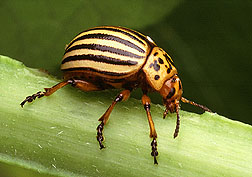
Lab Diet for Wasps Spells Trouble for Potato Beetles
A team of ARS entomologists-turned-chefs is cooking up trouble for Colorado potato beetles. The recipe could cut the need for chemical insecticides for growing eggplant.
The diners will be massive numbers of a parasitic wasp known as Edovum puttleri. The female E. puttleri lays her eggs inside those of the potato beetle, which never hatch. ARS entomologist Benjamin Puttler, now retired, discovered the wasp in South America in the 1970s.
Field trials have shown the wasp can allow commercial eggplant growers to use 4 instead of an average 14 insecticide applications to control the pest. But it's relatively costly and inefficient to rear the wasps on a diet of beetle eggs. That's because beetle eggs must be harvested from beetles raised on potato plants—a relative of the eggplant—grown indoors.
An ARS research team aims to cut out the beetle and potato plant middlemen. Their experimental artificial diet mimics the beetle eggs' contents with chicken egg yolk, powdered milk, and insect bloodlike hemolymph. The scientists even devised artificial egg membranes to house the wasp's growing brood. Still needed: a cheap, off-the-shelf substitute for hemolymph. It holds critical substances that trigger the wasp larva's development into an adult.
Dale Gelman, USDA-ARS Insect Biocontrol Laboratory, Beltsville, Maryland; phone (301) 504-8909, fax (301) 504-5104
In Future, Potato Chips-To-Be May Not Need a Warm-Up
Thanks to ARS scientists in Wisconsin, a wild relative of the potato might someday mean less time and expense for giving potato chips the light color consumers demand.
Today, potatoes taken from cold storage must be slowly warmed—during a month-long reconditioning period—before they can be processed into chips. Without this step, accumulated sugars will give chips an unacceptable dark-brown, burnt-looking appearance. No commercial varieties can be processed directly from cold storage. That's where Solanum raphanifolium comes in. The tubers of this native of Argentina and Bolivia can be processed into light-colored chips directly from cold storage.
ARS scientists identified the trait while painstakingly screening more than 80 wild potato species. Then, by crossing S. raphanifolium with relatives of commercial varieties, the scientists developed new breeding lines. Hybrids from these lines were chipped directly from cold storage, cutting the reconditioning time to 1 week.
The scientists have provided the new lines to public and private breeders. New varieties could appear within several years. There's an added benefit to potatoes that can be chipped from cold temperatures: less need for chemicals to inhibit sprouting during storage. Many chemically based sprout inhibitors are being eliminated by the Environmental Protection Agency.
USDA-ARS Vegetable Crops Research Unit, Madison, Wisconsin; phone (608) 262-1248
"No Hands" Scale
A new scale with agricultural uses could also prove useful in manufacturing, to determine the mass of objects dangerous to touch, such as molten ceramics and glass.
ARS research engineers originally designed and patented the scale to measure corn-kernel moisture. It uses microwaves to measure the grain's moisture content without harming the kernels. It also works with peanuts and soybeans—other commodities for which moisture content can be critical.
The new scale is fast—it can take a measurement in 20 thousandths of a second—and can be made from readily obtained components.
ARS is seeking to license the technology, based on a phenomenon called the microwave resonant cavity. This cavity marks the disturbance an object creates as it moves through a microwave field. On the basis of this measurement, the scale can calculate mass and moisture content and reveal defects without harming an object.
Stuart O. Nelson, USDA-ARS Richard B. Russell Research Center, Athens, Georgia; phone (706) 546-3101
