
United States Department of Agriculture
AgResearch Magazine


Yeast Collection on the Rise
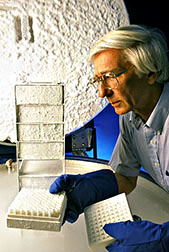 Yeasts retrieved from the deep freeze by microbiologist Cletus Kurtzman will be used to develop molecular probes for rapid identification of different strains. (K7406-3) |
Imagine matching a pair of socks color-for-color, size-for-size all of your life, then opening the drawer one day to discover some pairs really weren’t similar even if they looked alike, and other pairs were a perfect match even though they appeared to be a different color?
Agricultural Research Service scientists in the Microbial Properties Research Unit at the National Center for Agricultural Utilization Research (NCAUR) at Peoria, Illinois, have expanded their knowledge of over 80,000 yeasts, molds, and bacteria that are part of the largest publicly accessible collection of such organisms in the world.
Like sorting through a giant sock drawer, they've found new categories and discovered new matches through DNA sequencing, a process that uses specific sequences of nucleotides for identification. The nucleotide sequence is unique to every organism and reveals similarities and differences not apparent in other classification systems, such as comparing outward appearance or metabolism.
"We distribute about 4,000 strains of molds, yeasts, bacteria, and actinomycetes annually to businesses, domestic and foreign government agencies, universities, and other research facilities," says ARS microbiologist Cletus P. Kurtzman. "Through our molecular genetic studies we can make informed recommendations for the exploitation of these organisms for biotechnological purposes."
Like detectives working to solve a puzzle, the scientists use DNA sequencing to give them clues about a particular organism—such as whether it might be used for biocontrol, in food processing, or to recognize a potential pathogen of plants or humans.
Under the old system of classification, scientists would group organisms together by comparing their shape, size, and growth on specific nutrient media. DNA sequencing allows scientists to match specific nucleotides and to identify separate species.
The scientists at NCAUR have used this knowledge to create unique databases that they access to quickly and accurately identify yeasts, molds, or bacteria that may pose a threat—or afford an advantage—to humans or agricultural crops.
For example, Kurtzman has developed a special database to identify yeasts of potential economic importance to the fermentation industry. These studies recently led researchers to the discovery of a yeast in the NCAUR collection that can be used to ferment L-arabinose, a five-carbon sugar found in agricultural wastes such as the fibers left from wet-milling of corn. (See "Improving Ethanol Yield From Corn," Agricultural Research, Oct. 1996, pp. 8-11.)
DNA sequencing also helps assess biodiversity among species of organisms. Stephen Peterson, an ARS microbiologist, has used DNA sequencing in his work with Aspergillus and Penicillium, organisms used in food processing and medicine. He notes some species of Aspergillus are useful in making food processing preservatives such as the citric acid in soft drinks, and some species of Penicillium are useful in fermenting cheeses like Brie, blue, and Stilton.
ARS microbiologist Kerry O'Donnell has used DNA sequencing to develop a one-of-a-kind database to rapidly identify different species of Fusarium, a mold that produces toxins that can attack economically important crops. Using information gleaned from DNA sequencing, O'Donnell has been able to successfully identify several species of the fungus and trace them to the country of their origin. This helps scientists understand how the fungus traveled and how it may attack economically important crops.
"Species of the genus Fusarium collectively represent one of the most important toxin-producing molds threatening agricultural crops and commodities throughout the world," O'Donnell says.
Still other DNA-sequence databases under development at NCAUR include one for Bacillus bacteria and another for agriculturally and industrially important species of the actinomycete Streptomyces. -- By Dawn Lyons Johnson, ARS.
Cletus P. Kurtzman is in the USDA-ARS Microbial Properties Research Unit, National Center for Agricultural Utilization Research, 1815 N. University St., Peoria, IL 61604; phone (309) 681-6561
"Yeast Collection on the Rise" was published in the December 1996 issue of Agricultural Research magazine.
