
United States Department of Agriculture
AgResearch Magazine


Hardy Oats Stand Up to a Cold World
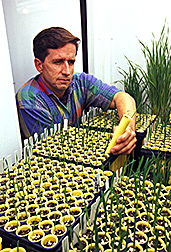 Winter oat seedlings grown by agronomist David Livingston will be ready in about 3 weeks for first-phase hardening at temperatures just above freezing. (K7425-14) |
Of all fall-sown grain crops, oats are the most vulnerable to freezing before spring. But understanding how their natural defenses work may uncover new ways to toughen them up, a USDA scientist says.
"Winter oats are grown mainly in regions below Virginia. Barley, the next hardiest crop, goes as far north as Pennsylvania, wheat makes it to the Dakotas and southern Canada, and rye grows almost anywhere," says ARS plant physiologist David P. Livingston. "But many farmers, especially in Pennsylvania and Ohio, would like to grow winter oats."
For all fall-sown crops, surviving winter depends on the regenerative part of the plant known as the crown, which is usually underground where the root and stem meet.
During cool fall weather, plants slow their growth, diverting their carbohydrates into this "biological backpack" to fuel new spring growth. The leaves and roots may die, but if most of the regenerative cells in the crown can keep the ice out, the plant will survive to regrow in spring.
Livingston has been exploring whether carbohydrates might play a role in freeze protection.
The Russian scientist I.I. Tumanov reported in 1931 that winter crops have two distinct winter preparation phases. In phase one—just above freezing—the plant stores carbohydrates and undergoes other biochemical changes. But in the second phase—just below freezing—the plant seems to be using the sugars in some way, as was reported by Soviet scientist T.L. Trunova in 1965.
Livingston's mentor, ARS scientist C. Robert Olien, was among the first American researchers to explore the second phase. He found plants moved their sugars into the space between the cells, known as the apoplast, which is mainly water. This could be a sophisticated survival trick.
"Ever notice how ice cubes will stick to your fingers, especially if they're clean? That's because the ice molecules are playing tug-of-war with your outer skin cells, vying for a very thin moisture layer. It doesn't hurt your fingers, but the forces can rip the oat crown cells apart during freezing," explains Livingston.
"Olien showed that these sugars could provide a protective barrier, minimizing or even preventing the cell destruction."
Olien's work with barley and rye led Livingston to similar studies with oats. He found that when oats were exposed to -3° C for 48 hours, nearly half the plant's glucose and 13 percent of its fructose were in the apoplast. He also found that removing these sugars from the crown halved its freezing tolerance.
It appears that the cells were breaking down fructan—a stored sugar that's a chain of fructose linked to sucrose molecules—and moving it into the space between the cells.
"It could be the sugars lower the freezing point of the water in critical regions of the crown or that they alter the shape or size of the ice crystals so they're less likely to damage cells," Livingston says.
He spends a lot of time comparing notes with other ARS researchers who specialize in cold hardiness. Sharing research gives them insights not only into the various winter crops, but also into the complementary biology of freeze resistance.
For example, Livingston, a carbohydrate specialist, collaborates with ARS plant physiologist Cynthia Henson in Madison, Wisconsin, who is an expert on enzymes used to break down carbohydrates. Both researchers keep in touch with Elliot Herman, an ARS plant physiologist in Beltsville, Maryland, who uses an electron microscope to study how proteins and other compounds protect winter crops. And ARS plant physiologist Kay Walker-Simmons in Pullman, Washington, provides information on how hormones are involved in protecting plants from freezing injury.
"Cold hardiness is the result of several survival mechanisms working together," says Livingston. "Without scientific collaboration, it would be easy to get so focused that you forget that." -- By Jill Lee, ARS.
David Livingston is in the USDA ARS Plant Science Research Unit, North Carolina State University, Box 761, Raleigh, NC 27695-7614; phone (919) 515-4324.
"Hardy Oats Stand Up to a Cold World" was published in the December 1996 issue of Agricultural Research magazine.
