
United States Department of Agriculture
AgResearch Magazine


Pear Bars—A Tasty New Treat |
|
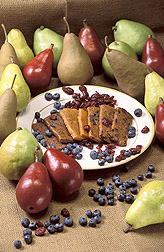 New, ARS-developed pear bars capture fresh fruit taste. Some contain blueberries or cranberries, too. (K10103-1) |
If you like fresh pears, you'll want to try a new, 100-percent fruit snack called a pear bar. This cinnamon-colored treat is "soft and chewy, with an intense pear flavor," says ARS food technologist Tara H. McHugh at Albany, California. McHugh and colleague Charles C. Huxsoll, an agricultural engineer, patented the food-processing technology that made it possible to create an all-natural fruit bar that doesn't crumble and stays fresh without the need for artificial preservatives. They did the work in their laboratory at the ARS Western Regional Research Center at Albany. The bars, about the size of a typical granola bar—but a bit slimmer—will be made and marketed by HR Mtn. Sun, Inc., of Hood River, Oregon. The scenic Hood River valley is one of the nation's premier pear-producing regions. The bars represent an innovative new way to process pears. HR Mtn. Sun, Inc. holds an exclusive license for the novel technology. Under terms of a cooperative research and development agreement, company specialists are working with McHugh and Huxsoll to ready the food-making process for production. Plans call for the pear-bar product line to include not only the basic bar, which has bits of dried, diced pears for added texture, but also a flavorful pear-blueberry bar and a zesty pear-cranberry bar. All will be a boon for the region's producers, as well as for consumers looking for a new way to enjoy these perishable fruits. Most pears grown today are either sold fresh or they're canned, dried, or processed into fruit cocktail, nectar, juice, baby food, or other familiar offerings. Like fresh pears, pear bars provide fiber, vitamin C, and several minerals, including iron and potassium. But, unlike the fresh-market fruit, pear bars aren't perishable and will be available year-round. The bars are made by processing pears into puree and concentrate to capture their freshness and flavor. After the rush to ship the fresh-market crop to buyers nationwide and overseas subsides, the puree is either spray- or drum-dried, then mixed with concentrate. The mixture is shaped into bars using a standard piece of food-processing equipment known as an extruder. "The technique is fast, easy, energy-efficient, and relatively inexpensive," McHugh says. "It can also be used to produce other all-natural food items from other fresh fruits, and from vegetables, as well. That should make it easier for everyone to get the recommended 5 to 9 daily servings of fruits and veggies needed for good health."—By Marcia Wood, Agricultural Research Service Information Staff. This research is part of Quality and Utilization of Agricultural Products, an ARS National Program (#306) described on the World Wide Web at http://www.nps.ars.usda.gov. For further information about U.S. Patent No. 6,027,758, "Restructured Fruit and Vegetable Products and Processing Methods," contact Tara H. McHugh or Charles C. Huxsoll, USDA-ARS Western Regional Research Center, Processed Foods Research Unit, 800 Buchanan St., Albany, CA 94710; phone (510) 559-5650, fax (510) 559-5851. "Pear Bars—A Tasty New Treat" was published in the December 2002 issue of Agricultural Research magazine.
|
