United States Department of Agriculture
AgResearch Magazine


Census Shows Where Milkweed Grows
|
||
|
Conservationists and others concerned about the fate of the monarch butterfly may be heartened by a recent survey of milkweed distribution in the major U.S. corn-growing area.
In May 1999, new questions arose aboutBacillus thuringiensis (Bt), a soil bacterium used for 35 years as an effective alternative to chemical insecticides for controlling moth pests. Its use—either as a spray or through genetic insertion into crops—has grown over the years because it reputedly doesn't harm humans, animals, beneficial insects, or other crops. But a note published in Nature questioned that: A small, preliminary laboratory experiment suggested that Bt corn pollen has a negative effect on monarch butterflies because of its drift onto nearby milkweed plants, a primary food source for the butterfly. |
|
|
In laboratory feeding experiments, monarch larvae fed milkweed leaves artificially coated with pollen fromBt corn ate less, grew more slowly, and suffered a higher death rate than larvae that consumed milkweed free of the pollen.
Bt transgenic plants have been used since 1996 because farmers get excellent crop yields without spraying pesticides. The note inNature raised some concern about the crop's possibly harming nontarget species in areas whereBt corn is grown extensively. "Common milkweed, Asclepias syriaca, is a plant native to the northeastern and north central United States and adjacent areas of Canada. It's an important component of the life cycle of the monarch butterfly, Danaus plexippus," says Douglas D. Buhler. Formerly an ARS agronomist at the National Soil Tilth Laboratory in Ames, Iowa, he now chairs the Department of Crop and Soil Sciences at Michigan State University-East Lansing. |
|
|
"Monarchs lay their eggs exclusively on plants in the milkweed family, Asclepiadaceae, usually on the underside of a leaf," says Buhler. "There are over 100 milkweed species in North America, but common milkweed is the most prevalent and the main host for monarchs in the Midwest.
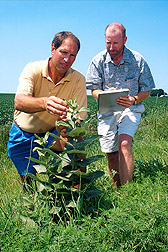
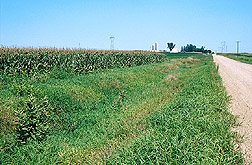
"Common milkweed and other closely related plant species are the sole food source of monarch larvae, or caterpillars," he says. "They feed on milkweed foliage, flower buds, and milky juice. The importance of common milkweed populations in the central United States to the monarch—coupled with concerns about toxicity to its larvae of pollen from one variety ofBt corn deposited on milkweed leaves—has generated considerable interest in knowing how milkweed is distributed in croplands and adjacent areas." Buhler adds, "We also need to know the larvae's potential for exposure to the pollen in the real world, so we must determine where milkweed grows in relation to corn fields." A Different Kind of Census To determine the relative distribution of common milkweed in different habitats in Iowa, Buhler, working with ARS technician Keith A. Kohler and Iowa State University-Ames weed scientist Robert G. Hartzler, conducted the first intensive survey of the state's farmlands and adjacent areas. They wanted to better understand the role of this native plant's ecology in the life cycle of other organisms. "In June and July 1999, using a random, representative sample of Iowa farmlands, we selected 40 areas that were each 38.6 square miles, using a coordinate reference system," says Kohler. "We were interested in knowing the population dynamics and geographic distribution of common milkweed." Within these sample units, the team arbitrarily selected 10 areas, each 55 yards by 110 yards. The areas included all possible habitats where the weed commonly grows—corn and soybean fields, pastures, roadsides, and land maintained in the Conservation Reserve Program (CRP) of the USDA Natural Resources Conservation Service. The researchers found common milkweed growing along 71 percent of the roadsides and in about half of the corn and soybean fields sampled. Pastures had the lowest occurrence of milkweed—28 percent. Corn and soybean fields had 85 percent fewer patches of common milkweed than roadsides. "While common milkweed was often found in corn and soybean fields, the average frequency and patch sizes were much greater along roadsides and in other undisturbed areas," says Buhler. "Roadsides had 22 patches per acre, whereas corn and soybeans averaged 3." According to Buhler, "CRP fields had relatively few patches—about four per acre. However, these patches were larger than those in other settings. This resulted in CRP land having the highest percentage—2 percent—of area infested with common milkweed." He says, "Land in cornfields, soybean fields, or pastures had the lowest average area infested—less than 0.03 percent—but these land uses cover 78 percent of the Iowa land mass." These results are of great interest to those studying the proportion of milkweed population that may be affected by changing herbicide-use patterns in crop fields—and the potential impact ofBt pollen on monarch populations. The study will be of great interest to scientists studying the fate ofBt corn. This research also provides vital information about the distribution of common milkweed in Iowa—the major U.S. corn-producing state—and in areas with similar climate and land-use patterns. But, says Buhler, "Additional information is needed before an accurate assessment can be made of the impact of genetically modified crops on monarch butterflies."—By Hank Becker, Agricultural Research Service Information Staff. This research is part of Soil Resource Management, an ARS National Program (# 202) described on the World Wide Web at http://www.nps.ars.usda.gov. Douglas D. Buhler is with the Department of Crop and Soil Sciences at Michigan State University, East Lansing, MI 48824; phone (517) 355-0217, fax (517) 353-5174. Keith A. Kohler is with the National Soil Tilth Laboratory, 2150 Pammel Dr., Ames, IA 50011-3120; phone (515) 294-8240, fax (515) 294-8125. |
|
|
"Census Shows Where Milkweed Grows" was published in the December 2000 issue of Agricultural Research magazine. |
||