
United States Department of Agriculture
AgResearch Magazine


A Gut Issue—Measuring Iron Bioavailability
|
|
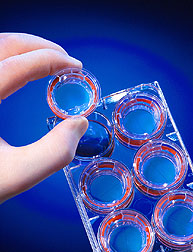
An Agricultural Research Service scientist has invented an "artificial gut" that promises to accelerate our knowledge of the amount of iron biologically available to us from our food and food supplements. The research has already led to suggestions for improving the nutritional makeup of infant foods.
"Iron deficiency is the world's most prevalent nutrient deficiency. Even in developed countries, it remains a serious concern for women during pregnancy and throughout their childbearing years," says ARS human physiologist Raymond P. Glahn. He is with the agency's U.S. Plant, Soil, and Nutrition Laboratory in Ithaca, New York. "It is extremely important that pregnant women and children receive proper iron nutrition," he adds.
To help correct these deficiencies, Glahn has developed an in vitro laboratory model. "This model gut is unique," he says, "because it couples simulated food digestion with a human intestinal cell line called Caco-2."
Glahn says his system is the first to accurately model in the lab what occurs in the human intestinal tract. It allows food digestion to occur at the same time nutrients are taken up by the Caco-2 cells. He expects the model to have broad applications for studying staple foods like rice, corn, wheat, and beans; food supplements; pharmaceutical iron preparations; and baby foods, including formula, cereals, and purees.
What's Really Available to Us
"Simply measuring the amount of iron in foods is not adequate," says Leon V. Kochian, who heads the Ithaca laboratory.
"To improve our food supply, we must have some measure of how much iron we can expect to actually absorb. We can use Glahn's model as a fast, inexpensive method for determining the relative availability of iron from different foods or from different crop varieties used in the same food," says Kochian.
For example, the model gut could be used to screen dozens of rice varieties for high iron availability. Cost prohibits animal studies of this type—not to mention human trials. "Human feeding trials are very expensive," Kochian says. "This model can help researchers refine the experimental design of human trials so as to make more productive use of funds. And the model can address experimental questions that are not feasible or appropriate to address in a human study."
Caco-2 cells resemble the human intestinal epithelial cells that line the inner surface of the small intestine and absorb nutrients from the foods we eat," says Kochian. "Caco-2 cells have been widely accepted by nutritionists as a model of human absorption."
|
|
To combine digestion with cell culture, Glahn needed a way to protect the Caco-2 cells lining the bottom surface of culture wells from digestive enzymes and microorganisms. He achieves this by dividing the well into upper and lower chambers on the day of an experiment. As a separator, he uses a dialysis membrane attached to a plastic insert specifically designed to fit inside each half-dollar-sized culture well.
In the upper chamber—directly on the membrane—Glahn places a food sample and enzymes that digest it over a period of about 3 hours. The dialysis membrane prevents the digestive enzymes and microbes from reaching the Caco-2 cells in the lower chamber. This mimics the role of the mucus layer that protects epithelial cells of the human digestive tract. Nutrients and minerals pass through the membrane to the waiting Caco-2 cells.
To find out how much of the food's iron is available to the Caco-2 cells, Glahn measures the amount of ferritin—an iron storage protein—in the cells. "We have demonstrated that ferritin formation is a highly sensitive and accurate measure of iron uptake," he says.
According to Kochian, "Glahn's model is expected to function well as a screening tool for plant foods and for developing food products. With this model, scientists can measure food-iron availability directly from the producer or supermarket shelf."
The Model's Many Advantages
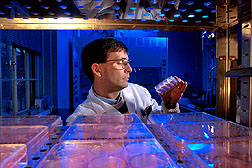
Doing the studies with cells instead of animals is cheaper and faster. Glahn can test six experimental conditions at a time, since a culture plate holds six wells.
"The cost per culture plate is about $4.50, compared to about $54 to purchase six rats for animal studies," he says. "Furthermore, collecting data takes only 3 days with the model gut, compared to 10 with the rats."
There's another advantage of the cell-based test: Currently, researchers who conduct most human and animal feeding studies of iron uptake have to add a minute amount of radioactive iron to a food sample so they can track absorption of the iron in it. Radioactive iron isn't used with Glahn's model gut.
"Our model eliminates the controversy, costs, and inconvenience associated with food-iron radiolabeling," Glahn says. "Although a sensitive method, radiolabeling of food iron can be expensive and controversial. It also requires extensive training and monitoring of the radioactivity, adding further to costs."
By avoiding radioisotopes, Glahn's model is more user-friendly for scientists in academia, government, and private industry. It may enable many research groups to run analyses previously beyond their means.
Glahn says "estimating cost-savings of our model system versus human or animal trials is difficult, but we estimate it to cost 20 percent as much as an animal trial. The savings are probably greater for a human study."
Iron for Infants
So far, Glahn and coworkers have used the cell-model system to investigate iron availability of rice cereal, infant formulas, and iron supplements. The coworkers are Cornell University technician Jean S. Hsu, retired ARS biochemist John F. Thompson, and Cornell University undergraduate students Jennifer Cha, Matt Goldman, Cindy Lai, and Olivia Lee.
For their first application of the model, they found that adding vitamin C to infant rice cereal increased the amount of available iron. At current levels of iron fortification, the team found that a 2-to-1 ratio of vitamin C to iron was necessary to maximize availability of iron from the cereal.
|
|

In a related study, they determined that mixing the infant rice cereal with water fortified with vitamin C increased iron availability more than mixing it with vitamin C-fortified apple juice. "Our findings suggest apple juice contains one or more substances that offset the vitamin's beneficial effects on iron uptake," Glahn says.
"It's an excellent example of how the food-product industry can use this model system to improve nutrient content and offer consumers a better product," he says. The research was funded in part by a grant from Gerber Products Company of Fremont, Michigan, a major baby food manufacturer.
For their next study, Glahn's team assessed iron uptake from human breast milk and from infant formula made with cow's milk.
"Citric acid, a natural organic acid present at levels several times higher in cow's milk than human milk, decreased iron availability," he says. "Unless citric acid levels are significantly reduced, adding an iron-uptake promoter, such as vitamin C, to the formula at a palatable level would not overcome the effect of citric acid."
Glahn says manufacturers of cow's-milk-based infant formula could improve iron availability by decreasing the citric acid concentration. "The question is whether a company could do this cost-effectively," he says.
Plant Breeders Could Bolster World Health
The most far-reaching application of Glahn's model involves its use as a screening tool for identifying breeding lines of staple food crops such as rice, wheat, maize, and beans for improved iron availability. Glahn's model gut was developed with precisely this application in mind.
"With over 2 billion people in the world suffering from micronutrient malnutrition, we need to find sustainable ways to improve absorption of iron, zinc, vitamin A, and iodine. One way to do this is to produce crops from which more of these micronutrients can be absorbed.
"However, because the cost of animal and human trials limits their use in this task," Glahn says, "we haven't had a method for screening the hundreds of varieties that plant physiologists have identified for this approach."
Initial screenings of rice and bean varieties indicate that this model gut is well-suited to the task. Glahn says there's now a team using this model to identify lines of staple foods with improved iron availability.
"This application of the model is part of a multisystem approach aimed at disrupting the devastating effects of micronutrient malnutrition in target populations and developing countries," he says. "Our goal is to use agriculture to its fullest extent to alleviate iron deficiency."
Glahn says his model "was validated by reproducing effects similar to those consistently observed in human studies. This was achieved many times under different experimental conditions. Every time, the model matched, on a relative basis, those effects known to occur in humans."
Glahn has applied for a U.S. patent on his model gut. He is currently negotiating a license with a private laboratory to produce an iron bioavailability kit.
"The kit would make the unique components of this model available to other investigators," he says.
Meanwhile, Glahn and his research team continue to apply, adapt, and refine their model. Glahn believes it can eventually be used to measure bioavailability of other micronutrients, such as vitamin A, zinc, selenium, and iodine.
"Humans need these micronutrients in much smaller quantities than macronutrients such as carbohydrates, fats, and proteins," he says. "Yet, they are critical to good health." — By Hank Becker, Agricultural Research Service Information Staff.
This research is part of Human Nutrition Requirements, Food Composition, and Intake, an ARS National Program described on the World Wide Web at: http://www.nps.ars.usda.gov/programs/appvs.htm.Raymond P. Glahn is at the USDA-ARS U.S. Plant, Soil, and Nutrition Laboratory, Tower Rd., Cornell University, Ithaca, NY, 14853-2901; phone (607) 255-2452, fax (607) 255-1132.
"A Gut Issue—Measuring Iron Bioavailability" was published in the August 1999 issue of Agricultural Research magazine.
