
United States Department of Agriculture
AgResearch Magazine


DNA Probes Foil Spoilage Yeasts
|
|
Spoilage yeasts that lurk inside wine as it ferments and ages pose a major challenge to winemakers. These yeasts, which cause displeasing odors and flavors, can ruin a batch of otherwise fine wine.
It takes up to a week to test wine samples for potential yeast spoilage problems, says microbiologist Neil Brown of Vinquiry, Inc., based in Windsor, California. Vinquiry, which specializes in analytical services, research, and consulting, has clients worldwide but primarily in northern California's wine country. For many of these clients, spoilage yeasts could mean big losses.
Now Agricultural Research Service scientists, armed with the latest biotechnology tools, may be able to put Brown and others in the wine industry at ease.
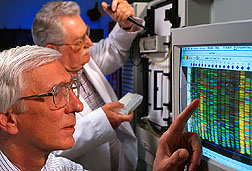
Winemaking was set for change 2 years ago when, at an American Society for Microbiology (ASM) meeting, ARS microbiologist Cletus P. Kurtzman attested to what state-of-the-art research tools can do. He reported that with about 4,000 hours of work, he and his colleagues had done what might have taken whole careers to achieve with older technology.
Based on unique segments of genetic material, or DNA, the researchers had cataloged representative strains of all ascomycetous yeasts, a group so named because they reproduce sexually in saclike structures called asci.
The presentation piqued the interest of colleagues such as James M. Coull of Boston Probes, Inc., in Bedford, Massachusetts. Informal conversations led to a cooperative research and development agreement (CRADA) to tap a virtual treasure of some 500 ascomycete species.
Under the CRADA, some of each species' DNA sequences detailed in Kurtzman's computer database would serve as a starting point for developing molecular DNA probes to quickly analyze food and other products for particular microbes.
Made from short fragments of DNA or its RNA copy, molecular probes seek out and bind like a zipper to DNA sequences that are complementary to their own. A fluorescent or chemiluminescent tag is typically added to the DNA probe. The tag gives telltale evidence the probe has bound itself to the target DNA.
In the case of winemaking, for example, filter-collected microbial cells treated with probes might reveal spoilage yeasts of the genus Brettanomyces. Analysis of the wine by molecular probes would take a day or less. Currently, the microbes from wine samples must be grown in culture about a week and then analyzed through visual and biochemical tests.
Samples of the Brettanomyces and all other known ascomycete yeast species are kept in the ARS Culture Collection's frozen storage vaults housed at the National Center for Agricultural Utilization Research (NCAUR) in Peoria, Illinois. Kurtzman, head of the Microbial Properties Research Unit, curates the yeast collection.
|
|
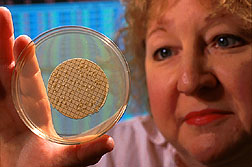
Some Ascomycetes, like bread yeasts, exert a positive economic impact. Others are best known as spoilers, posing difficulties for manufacturers of mayonnaise and other processed foods and drinks.
Winemakers would be happy if rising populations of undesirable fermentation microbes could be detected by a simple test kit before they get so far out of hand that massive amounts of a product must be discarded. Such a test kit will soon be forthcoming as molecular probes are developed under the CRADA.
Although heavily contaminated grape juice could be filtered to remove spoilage yeasts, the filtration process would likely ruin the flavor of the final product. Thus it would not be suitable for winemaking.
Early Detection Is Key
Winemakers and food and drink processors just may be among the first to benefit from new technology to quickly and easily identify these yeasts. In time, the dividends will be much more far-reaching, Kurtzman says. Medical professionals, for example, hope to improve their diagnostic accuracy as they deal with clinically serious yeasts like Candida that cause skin and deep-tissue infections. This should markedly improve treatment, as well as diagnosis.
When Coull learned of Kurtzman's research, he related it to a technology pioneered by Boston Probes. The 3-year CRADA between ARS and Boston Probes marks the first attempt to develop commercial use of a database that details the genetic blueprints of an entire group of microorganisms.
Boston Probes recently patented synthetic DNA mimics that could be used to precisely identify infectious diseases or genetic disorders that manifest themselves, even if in small measure, in various types of biological samples.
New and Improved Design
The specificity and sensitivity of the new probes were attributed to their design—which also helps them work faster, longer, and harder.
While conventional probes are built on a backbone of deoxyribose and phosphate, those built with Boston Probe's patented technology have a peptide backbone. Consisting of a short chain of amino acids, peptide-based probes attach better to specific kinds of DNA molecules. If tagged with a variety of labels, multiple probes can detect several DNA sequences in a single test.
As the U.S. National Institutes of Health and its collaborators near completion of the Human Genome Project—which unravels the entire human genetic code—probe-based diagnostic tests could grow into a $750 to $800 million market in the next 4 years, Coull says.
While the Human Genome Project has been a tremendous undertaking, unraveling just some of the unique DNA sequences in all known ascomycete yeast species was an ambitious, if less daunting, task for Kurtzman and laboratory technician Christie J. Robnett.
"Three biochemical technologies sped the process for us," Kurtzman says.
These were chemiluminescent tagging of DNA; polymerase chain reaction (PCR)—the process for making numerous copies of a small stretch of DNA; and automated DNA sequencing based on the other two technologies. The automated sequencing, often done by chemist Larry W. Tjarks, is a process in which a computerized machine determines the order in which substances called nucleotides occur in DNA.
Each yeast species has thousands of genes on up to 16 chromosomes. At the ASM meeting, Kurtzman reported that in 97 percent of some 1,000 strains representing the 500 presently known ascomycete species, only one-fifth of 1 gene needed to be examined to identify the species. The remaining 3 percent of strains represented quite closely related species that can be identified with just a little more sleuthing.
The NCAUR researchers genetically analyzed the yeasts to find how closely certain species or strains in the ARS Culture Collection are related and to thereby ensure that each is properly classified. An understanding of relatedness is important to epidemiologists—as well as to companies trying to protect their patents and to researchers who want to predict a microbe's usefulness for industrial purposes.—By Ben Hardin, Agricultural Research Service Information Staff.
This research is part of Plant Microbial and Insect Germplasm, Conservation and Development, an ARS National Program described on the World Wide Web at http://www.nps.ars.usda.gov/programs/cppvs.htm.
Cletus P. Kurtzman is in the USDA-ARS Microbial Properties Research Unit, National Center for Agricultural Utilization Research, 1815 N. University St., Peoria, IL 61604; phone (309) 681-6561, fax (309) 681-6672.
"DNA Probes Foil Spoilage Yeasts" was published in the August 1999 issue of Agricultural Research magazine.
