
United States Department of Agriculture
AgResearch Magazine


On Barley—A Rust of Another Stripe
|
|
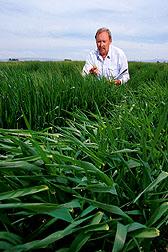
When barley stripe rust started powdering plants and sapping yields in the Pacific Northwest in 1995, USDA's Agricultural Research Service was as ready as could be under the circumstances. Agency scientists knew they were facing a new fungal disease. They also knew that farmers had no resistant barley variety and no adequate fungicide registered to fight it.
Many of them—like ARS plant pathologist Roland F. Line, an international expert on a similar disease that affects wheat, and ARS agronomist Darrell M. Wesenberg, an expert on barley breeding—had followed the spread of barley stripe rust from Europe to South America in 1975 and to the United States in 1991. David Marshall of Texas A&M University first observed the rust in Texas.
Line and Wesenberg are part of a broad effort to rein in the disease. Line is based at ARS' Wheat Genetics, Quality, Physiology, and Disease Research Unit in Pullman, Washington. Wesenberg is in the ARS Small Grains and Potato Germplasm Research Unit at Aberdeen, Idaho.
Their cooperators include other ARS researchers in Aberdeen, Pullman, and St. Paul, Minnesota; scientists at Centro Internacional de Mejoramiento de Maiz y Trigo, or CIMMYT, an international organization headquartered in Mexico; and state university scientists and private breeders throughout the western United States.
Natural Resistance, a First Defense
The researchers' teamwork to ward off the threat has focused primarily on exploiting the genetic rust resistance already present in wild and cultivated strains of barley plants.
|
|
The researchers have now developed some new, conventionally bred resistant barley. More varieties will arrive soon. And genetic engineering offers the possibility of more strongly resistant varieties for farmers in the future.
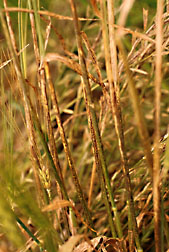
Barley stripe rust spreads by powdery, yellow spores. The spores are produced in large, yellow stripes between leaf veins, giving the leaves a striped, rusty appearance. The fungus may rapidly cover the leaves—and even the barley head—and effectively suck the plant dry.
"The rust causes rapid water loss, creating a drought for the plant no matter how much water is available," says Line.
The disease reached the Northwest's "backyard" in 1993, turning up in Arizona, southern Idaho, and Montana. It was then that Line started working under controlled conditions in the greenhouse with rust collections from the regions where barley stripe rust occurred in North America.
Line artificially infected plants from ARS' gene bank in Aberdeen—formally known as the National Small Grains Collection. He used DNA identification techniques and pathogenicity studies to show that the barley rust was "clearly different from wheat stripe rust, but closely related."
By 1995, Line confirmed what scientists had feared: The barley pathogen, like its wheat stripe rust cousin, was favored by cool, wet springs and mild winters. "Unfortunately, that meant the Pacific Northwest and California were tailor-made for it," he says.
Line has received reports of plants in California fields being so damaged that they weren't worth harvesting. "Wherever this disease shows up and is not controlled, it causes significant to severe damage at times. When severe, yield losses of 50 percent are not uncommon," he says.
More bad news: Line and Xianming Chen, an associate in his lab at Pullman, determined that the rust consists of at least 31 different races or strains. This means it could attack a wide range of barley varieties and easily create new races that might attack new resistant varieties that are developed.
|
|

By 1996, the fungicide Folicur became available to growers under an emergency authorization by the U.S. Environmental Protection Agency (EPA). Line provided research data that farmers and pesticide companies used in requesting the EPA approval—granted on a year-by-year basis. Line had found that Folicur protected barley late into the season, throughout all its vulnerable stages. He had also determined that at least two other fungicides are effective, and he is part of an effort to make them available, too.
Identifying the Resistance Genes
Line and Chen identified many sources of rust resistance in the Aberdeen collection. By making many crosses with susceptible varieties and among the resistant sources, they identified 26 genes for resistance. They also found which genes are common in the resistant sources.
Rust-resistance genes are now easier to locate, because of a new technique Line and colleagues developed for finding molecular markers linked to rust resistance.
"It's a real breakthrough—faster, more efficient, and less expensive," says Line. "It yields more markers, and it is directly associated with resistance genes." This technique is currently being used in cooperation with Patrick M. Hayes, a barley breeder at Oregon State University, to breed for adult plant resistance to the rust and other diseases.
To find barley with natural resistance to the destructive rust, ARS researchers at Aberdeen, Idaho, have meticulously screened hundreds of plants from the nation's barley gene bank at Aberdeen and elsewhere.
They did the work with Colorado State University and Bolivian scientists. Colleagues at Colorado State included plant pathologists William M. Brown, Jr., Joseph P. Hill, and Vidal Velasco.
ARS agronomist Harold E. Bockelman manages the Aberdeen gene bank that also houses wheat, oats, rye, and other small grains.
Field evaluations began in 1990 in Cochabamba, Bolivia. That location was chosen because the fungus was severe there, causing losses of 30 to 70 percent. "We started testing for stripe rust resistance before it showed up on any American farms," says ARS agronomist Darrell Wesenberg, "because it seemed likely the rust would eventually make its way into the United States."
At the Bolivia trials, the scientists identified several rust-resistant plants. A star performer was number 78Ab10274, a product of the ARS barley breeding program at Aberdeen. Later, 78Ab10274 also did well in trials at Toluca, Mexico, which had by then become another site of severe rust infestation. Hugo Vivar directed the Mexico trials for CIMMYT.
Tests in Idaho and several other western states showed that 78Ab10274 yielded as many bushels as most leading commercial varieties of spring barley. Scientists gave it the name "Bancroft" and expect to formally release it for commercial production this year.
Though tests have so far focused on Bancroft's performance as a feed barley, ARS scientists are also conducting field-scale trials to evaluate its potential for malting and brewing.
|
|
Engineering Better Barley
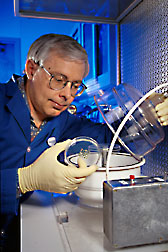
New techniques for gene-engineering barley may augment conventional breeding like that used to produce Bancroft and may hasten development of additional rust-resistant barley for the future. Biotechnologists Shibo Zhang, Myeong-Je Cho, and Peggy G. Lemaux of the University of California and ARS geneticist Phil Bregitzer at Aberdeen have come up with a new and better way to sidestep some of the problems that can occur when researchers try to slip new genes—such as genes for disease resistance—into barley cells.
Instead of moving the genes into plant embryo tissue—a common approach—the scientists recommend using what's known as cultured meristematic tissue, which is derived from the growing tip of the plant. They say this tissue is less likely to incur changes in its genetic makeup when it is bombarded by a gene gun—a device that shoots gene-coated particles into tissue.
Also, successive generations of plants derived from laboratory-cultivated meristematic tissue are less liable to develop natural differences, or mutations, known as somoclonal variation. Though desirable in some types of plant breeding, somaclonal variation can disrupt genetic engineering experiments.
What's more, embryonic tissue sometimes yields albino plantlets, while meristematic tissue—if cultivated according to lab procedures developed by the scientists—has a better chance of yielding fertile, green, healthy plantlets. Zhang, Cho, Lemaux, and Bregitzer are seeking a patent for their discoveries.—By Don Comis and Marcia Wood, Agricultural Research Service Information Staff.
This research is part of Plant Diseases, an ARS National Program described on the World Wide Web at http://www.nps.ars.usda.gov/programs/cppvs.htm.
Roland F. Line is in the USDA-ARS Wheat Genetics, Quality, Physiology, and Disease Research Unit, 361 Johnson Hall, Washington State University, Pullman, WA 99164-6430; phone (509) 335-3755, fax (509) 335-7674.
Darrell M. Wesenberg and Phil Bregitzer are in the USDA-ARS Small Grains and Potato Germplasm Research Unit, 1691 S 2700 W, Aberdeen, ID 83210; phone (208) 397-4162 [Wesenberg ext. 108, Bregitzer ext. 116], fax (208) 397-4165.
"On Barley—A Rust of Another Stripe" was published in the August 1999 issue of Agricultural Research magazine.
