
United States Department of Agriculture
AgResearch Magazine


Seed Imaging—New Tool in Germplasm Preservation
|
|
Digital technology is now helping scientists and engineers protect our genetic resources by recording and storing valuable information about seeds in an electronic form that computers can use.
"We're using digital imaging equipment to help identify seed that is in danger of dying in storage," says ARS agronomist Phillip C. Stanwood. "This will give us time to regrow seed and thus save genetic material that someday may be a source of insect or disease resistance for commercial crops."
All seeds lose some vigor, or ability to survive, during extended storage and must be regrown periodically to produce a new generation.
Root length is one test for vigor. But measuring it is an expensive and time-consuming process. So ARS researchers at the National Seed Storage Laboratory in Fort Collins, Colorado, developed a digital system that automatically records when seed germinates, how fast it sends out roots, and the root length.
Digital imaging, whether by television cameras in a laboratory or by data collectors aboard orbiting satellites, breaks a picture up into small dots, or pixels, with average values of light intensity assigned for each pixel. This digital information is analyzed immediately by a computer or saved to disk for later analysis. Encoded information can be decoded back into images humans can see.
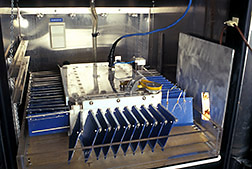
Scientists place test seeds on a carousel of 50 moist, blotter paper-covered boards that rotates inside a germination chamber. The chamber can maintain specific temperature and humidity requirements for each plant species being tested—lettuce and sorghum so far. A digital camera records images every hour as the boards make their circuit in front of the camera.
"Results we're getting from the new equipment are very close to those obtained by technicians actually measuring each seed," says Stanwood. He developed the equipment with engineer M. Scott Howarth at the lab.
"Although all seeds that germinated had the same germination—100 percent—we're learning more about each seed sample with much less work," says Stanwood. "Plant breeders could also use the system to select plants with the highest vigor and fastest growing roots."
The Colorado scientists are also using the digital equipment to build an image database on chickpeas, better known to salad bar patrons as garbanzo beans.
Information on 505 important accessions—out of almost 6,000 so far identified—will eventually be available. Each entry will include text explaining the seed's origin and botanic description. Pictures will show seed size, shape, and color; how the plant looks in the field—tall or short stature, for example; and how diseases and insects affect flowers and leaves.
Scientists are assisting others who are assembling digital databases of other key plant collections stored around the country. — By Dennis Senft, ARS.
USDA-ARS National Seed Storage Laboratory, 1111 S. Mason St., Fort Collins, CO 80521-4500; phone (970) 495-3226, fax (970) 221-1427.
