
United States Department of Agriculture
AgResearch Magazine


Multimedia Game
|
|
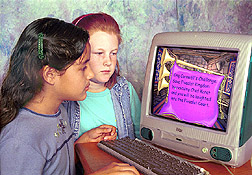 Developed at the Children's Nutrition Research Center in Houston, Texas, a computer game called "Squire's Quest" encourages children to consume an extra serving of fruit a day. Here, two 4th-grade students play the game. (K11380-1) |
Everyone agrees that the best time to establish good dietary habits is in childhood. But it's not always easy to get kids to eat what's good for them-like vegetables and fruits. A computer game developed by behavioral nutrition researchers at the Children's Nutrition Research Center (CNRC), Houston, Texas, has been shown to successfully increase fruit and vegetable consumption in elementary school students. The game is called "Squire's Quest," and students who played it ate an extra serving of fruit a day, according to Tom Baranowski. He's the study's lead scientist and a professor of pediatrics at Baylor College of Medicine. The results were published in the January 2003 American Journal of Preventive Medicine. In the game, the Kingdom of Fivealot is invaded by snakes and moles attempting to destroy the fruit and vegetable crops. The king and queen enlist the help of student "squires," who face challenges related to eating more fruit, juice, and vegetables. The squires gain points by preparing recipes in a virtual kitchen. At the end of the session, the students set a goal of making that recipe at home; eating another serving of fruit, juice, or vegetables at a meal or snack; or asking for a favorite fruit, juice, or vegetable to be more available at home. In the next session of the game, the student is rewarded with additional points if the goal was met. The study involved 1,578 students, all 4th-graders in the Houston Independent School District. They were divided into a participating group and a control group. Four days of dietary intake were assessed before and after the start of the 10-session game. "The program resulted in a one-serving increase in fruits and vegetables in only 5 weeks," says Baranowski. "This is remarkable considering that other programs, which attempt the same results, take up to 2 years to achieve their goals." People who consume more fruit, juice, and vegetables have some level of protection from several cancers, heart disease, and diabetes. While children do not ordinarily experience adult chronic diseases, some cancers have a long developmental period, perhaps starting at puberty. Food-related preferences and practices also start in the earliest years. Kids with high consumption of fruit, juice, and vegetables at younger ages generally remain higher consumers later in life. Educational multimedia games such as "Squire's Quest" may have potential to change dietary behavior. The CNRC is operated by Baylor College of Medicine, in cooperation with Texas Children's Hospital and the Agricultural Research Service.—By Alfredo Flores, Agricultural Research Service Information Staff. This research is part of Human Nutrition, an ARS National Program (#107) described on the World Wide Web at www.nps.ars.usda.gov. Thomas Baranowski is with the USDA-ARS Children's Nutrition Research Center, 1100 Bates St., Houston, TX 77030; phone (713) 798-6762, fax (713) 798-7098. "Multimedia Game Helps Kids' Food Choices" was published in the August 2004 issue of Agricultural Research magazine.
|
