United States Department of Agriculture
AgResearch Magazine


Bring On the Fat (Fatty Acids, That Is) |
|
|
|
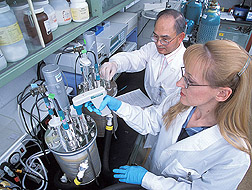
Thought vegetable oil was just for cooking? Guess again. ARS researchers in Peoria, Illinois, have devised a way to convert the oil's fatty acids into entirely new compounds having antimicrobial, medical, and industrial properties. One, called 7(S),10(S)-dihydroxy-8(E)-octadecenoic acid—or DOD—stopped the growth of Candida albicans yeast, a human pathogen, in laboratory experiments. Another, TOD, curtailed rice blast fungus, raising the prospect of a biofungicide to control this crop scourge. Both compounds are now patented and available for licensing and further testing by private industry. They're also recent examples of the Peoria researchers' efforts to open new market outlets for vegetable oils, particularly surplus soybean oil. The scientists' approach is called bioconversion, a process that uses certain microorganisms or enzymes to reposition groups of hydroxy fatty acids on chains of carbon in vegetable oils. "Using bioconversion, we can produce many value-added products from these fatty acids," says Ching Hou, a biochemist and lead scientist at the ARS National Center for Agricultural Utilization Research's Microbial Genomics and Bioprocessing Research Unit in Peoria. "The process can create completely new chemical entities." Key to bioconversion is a favorable environment in which its microbial workhorses—mainly bacteria and yeasts—can feed on and catalyze fatty acids inside special fermentation tanks called bioreactors. While not yet as efficient as chemically driven processes, bioconversion offers other advantages. "When you produce something by chemical means, there will be undesirable wastes generated as a result. Bioconversion is a more specific process and generates fewer byproducts," notes ARS chemist Tsung Kuo, who is exploring ways to scale up the technology and optimize the microbes' performance. One bacterium, a Pseudomonas aeruginosa strain called PR3, is the driving force behind a bioconversion process to produce DOD from oleic acid in soybean oil and TOD—7,10,12-trihydroxy-8(E)-octadecenoic acid—from ricinoleic acid in castor oil. The bacterial system converts up to 89 percent of oleic acid into DOD and up to 45 percent of ricinoleic acid into TOD in small fermentation flasks, reports Kuo. The Peoria bioconversion team also includes chemist Alan Lanser, support scientist Linda Manthey, and biological technicians Wanda Brown and Karen Ray. Biobased compounds have several potential uses. For example, DOD, in addition to stopping yeast growth, is structurally similar to surfactants, like those in soap, and has properties applicable for use in plastics and other industrial products. TOD is also antimicrobial. When sprayed onto plants, it provided varying levels of control against rice blast, wheat leaf rust, and three different blight pathogens. When mixed with water and acetone at 200 parts per million (ppm), TOD killed 100 percent of fruit flies and at concentrations of 250 ppm killed 90 percent of two-spotted spider mites. The Peoria scientists have produced three other novel compounds by bioconversion. One, called THFA for short, is derived from linoleic acid in soybean oil and resembles tetrahydrofuranyl compounds, which are known cancer fighters.—By Jan Suszkiw, Agricultural Research Service Information Staff. This research is part of Quality and Utilization of Agricultural Products, an ARS National Program (#306) described on the World Wide Web at http://www.nps.ars.usda.gov. Ching T. Hou, Tsung M. Kuo, Alan C. Lanser, Linda K. Manthey, Wanda K. Brown, and Karen J. Ray are in the USDA-ARS Microbial Genomics and Bioprocessing Research Unit, National Center for Agricultural Utilization Research, 1815 North University St., Peoria, IL 61604; phone (309) 681-6263, fax (309) 681-6672. |
|
"Bring On the Fat (Fatty Acids, That Is)" was published in the August 2002 issue of Agricultural Research magazine. |