
United States Department of Agriculture
AgResearch Magazine


What's New? HiMag Fescue
|
|
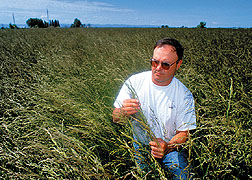
A hardy new grass called "HiMag" may help protect cattle, sheep, and goats from an affliction known as grass tetany.
When ruminants—animals with four stomachs—have too little magnesium in their blood, grass tetany can result. Also known as hypomagnesemia, grass tetany causes an estimated $50 to $150 million in livestock production losses each year in the United States.
Because it is unusually high in magnesium, the new tall fescue grass should help protect vulnerable animals from magnesium deficiencies. Plans call for HiMag seed to be made available to plant breeders this year.
Investigators Henry F. Mayland, who is with ARS at Kimberly, Idaho; Glenn E. Shewmaker, formerly with ARS and now at the University of Idaho; and David A. Sleper and colleagues at the University of Missouri developed HiMag in a cooperative effort that began in 1983.
As part of the HiMag collaboration, Shewmaker and Mayland scrutinized mineral levels of hundreds of candidate forage plants. They did the work at the ARS Northwest Irrigation and Soils Research Laboratory at Kimberly. HiMag had up to 20 percent more magnesium than some of the other plants they examined. And their greenhouse tests showed that levels of magnesium remained high in two successive generations.
So far, HiMag has been tested not only in Idaho and Missouri, but also in Utah, Texas, Arkansas, Georgia, Virginia, and New York, as well as in Canada. Scientists recommend it for rain-fed pastures in eastern, southeastern, and Pacific Northwestern states and British Columbia.
A Research First
The idea of breeding a high-magnesium forage grass to combat grass tetany isn't new. But the ARS and University of Missouri researchers are the first to accomplish that with tall fescue.
ARS grazing trials in Idaho with a dozen Angus and Angus-Hereford heifers indicated that the cattle find the plant palatable and will make profitable weight gains. When given a choice among HiMag and seven other tall fescues, HiMag garnered a respectable third-place.
Such a reality check with four-legged customers is crucial: Plant breeders elsewhere have learned the hard way that no matter how healthful a forage is, animals may turn up their noses at it if they don't like the taste or aroma.
The grazing test included only tall fescues that were free of a troublesome microbe known as an endophytic fungus. Cattle that graze on infected fescue may not gain as much weight as they should and may also have reproductive problems. Nevertheless, tall fescue is planted on more acres of American pastureland than any other type of forage grass.
Grass tetany is often fatal. Symptoms include nervousness, convulsions, and paralysis. Sometimes, potassium plays a role in the disease by outcompeting magnesium for what are known as absorption sites in an animal's gut. That can happen if hungry ruminants graze on pastures that have been overloaded with high-potassium commercial fertilizers or potassium-containing manure.
Preventive measures include adding magnesium to drinking water or salt licks or spreading it around the pasture with a fertilizer spreader. Each tactic has drawbacks. Spiking trough water with magnesium, for example, works only if animals will make the trip to the trough— which may be a mile or so away. They might choose instead to guzzle rainwater from a convenient puddle or ditch.
"A palatable, magnesium-rich forage," says researcher Shewmaker, "is a better guarantee that the animals will get the right amount of this essential nutrient."—By Marcia Wood, Agricultural Research Service Information Staff.
This research is part of Soil Quality and Management, an ARS National Program described on the World Wide Web at http://www.nps.ars.usda.gov/programs/nrsas.htm.
Henry F. Mayland is at the USDA-ARS Northwest Irrigation and Soils Research Laboratory, 3793 N. 3600 E., Kimberly, ID 83341; phone (208) 423-6517, fax (208) 423-6555.
"What's New? HiMag Fescue" was published in the April 1999 issue of Agricultural Research magazine.
