
United States Department of Agriculture
AgResearch Magazine


Harvesting Drugs From Medicinal Plants
|
|
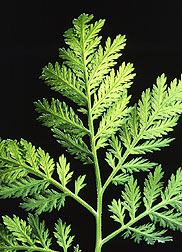
Ancient medical texts, some dating back to the early Greeks, talk about medicinal plants. Now modern science—including some done by USDA's Agricultural Research Service—is taking this ancient art to new levels.
Plant physiologist Stephen O. Duke heads ARS' Natural Products Utilization Research Unit at Oxford, Mississippi. Part of his research involves discovering how plants make their beneficial compounds and how to better extract them.
One example of his work is understanding the plant known as annual wormwood, Artemisia annua. This gray-green aromatic plant and its relatives in the genus Artemisia have been used to make absinthe and flavored wines since earliest times. Now this plant family could bring a new gift: Its natural pest-fighting defense may protect humans from malaria.
It's no secret that malaria-fighting drugs have done a lot for civilization—the Panama canal is one testimony of their success. But what happens when the organisms that cause the disease develop resistance to current treatments?
Right now, scientists are preparing to solve this problem before it ever occurs by having alternative treatments ready. One of these understudy cures could be artemisinin, a natural compound produced by Artemisia plants.
|
|
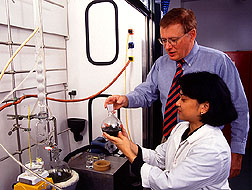
Medical researchers, especially in the military, want to know more about wormwood's malaria-fighting properties. That's because when duty calls U.S. troops to a tropical area, the disease is always a potential problem.
The question Duke wants to answer is exactly how the plant produces this potentially life-saving compound. Knowing the physiology would play a role in increasing the supply of this beneficial compound.
"It was already known that wormwood has little balloonlike glands on its leaf surface," Duke says. "We found that as the plant matures, these balloons fill with artemisinin. Pest protection is nature's goal. As the plant matures, the glands swell bigger and finally burst, covering the plant with self-made pesticide."
It is the natural pesticide aspect of annual wormwood that brings it even more within Duke's expertise. His research group's primary mission is to find natural products to control agriculture pests—especially in America's secondary crops.
There's money to be made in fighting pests, but it's mainly in protecting the nation's agronomic superstars—corn, wheat, and soybeans. That can mean that important, but less prominent, crops such as avocados and orchids are ripe for new protective treatments.
The scientists in Duke's research unit search the plant and microbial kingdoms for pest-fighters that work in harmony with the environment. Artemisinin, for example, may also yield its protective powers to otherwise vulnerable crops.
"We found that without the genetic coding for the gland, Artemisia won't produce artemisinin," says Duke. "For the plant, it's essential to have the genetic instructions for both the toxin and the storage mechanism."
|
|
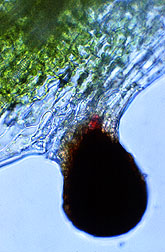
Knowing how a plant's DNA programs it for pest protection may lead researchers to ways to provide the same pest resistance to currently vulnerable plants.
Products for People Too
Besides the crop protection aspects of their research, Duke and his team of scientists are also looking at the pharmaceutical value of these plants. In fact, Artemisia is just one of the plants they're exploring.
Another plant that's intrigued Duke is St. John's-wort, which belongs to the genus Hypericum. Greek texts dating back to 2000 B.C. have noted uses and harvesting techniques for this plant. Currently, its claim to fame is as an alternative treatment for depression.
"St. John's-wort is the preferred treatment for mild depression in Europe," says Duke. "Physicians there choose it four to five times more often than synthetic drugs because they believe it has fewer side effects. Europeans get their supply from Albania, but it grows wild in the United States."
Much to the chagrin of ranchers who know St. John's-wort as a pest, horses and cattle that eat the plant develop a sensitivity to light, resulting in a rash, Duke says. Understanding the biochemistry involved might help reduce the effects.
But now, however, Duke's main concern is extracting a red pigment from the plant to benefit people.
St. John's-wort tablets are standardized by the amount of the red pigment, called hypericin, which some researchers suspect is the active ingredient. Hypericin is being studied as both an anti-viral and anti-cancer drug.
St. John's-wort has yet to receive FDA approval for use as a treatment for depression in the United States. But several companies are doing phase I and II clinical trials, a step toward gaining approval. Currently, Americans can buy St. John's-wort as a diet supplement.
Getting the Good Stuff Out
Finding an economical extraction method for hypericin would be helpful in developing St. John's-wort both for medicinal purposes and as an anti-viral agent. Since plant extraction and physiology are aspects of Duke's work, he began with research on the plant.
|
|
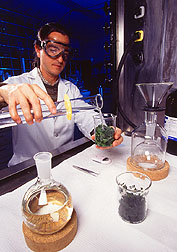
It was already known that hypericin was concentrated in small black and red dots found on the flowers and leaves of St. John's-wort and that it was effective in pest control. But hypericin, if given in a high enough concentration, is toxic to all living things, including St. John's-wort. The plant protects itself by sealing the hypericin dots off with a thin cell layer.
Normally, hypericin is extracted by chopping the plant up and extracting it with ethanol. But Duke may have a better way.
"The plant has other enzymes that can destroy hypericin when the cells containing the toxin are breached," he says. "Crushing the plant releases these hypericin-destroying proteins, defeating your purpose. We are looking at chemical extraction methods that may work better—like soaking the leaves in a solution that gently removes the hypericin without having to cut them."
While breeders and pharmaceutical companies are waiting to see what this plant can do, they can also stay tuned to Duke's research team. Already these scientists are hot on the trail of new helpful plants and better extraction techniques. Last fall, Duke had just finished completing his staffing, and the scientists were busy ordering equipment to start new research projects.
"All I can say is we are excited about the new research projects we've begun, and we're always looking for new ideas," says Duke. "We hope to excel in this new—and yet ancient—field of natural pesticides and pharmaceuticals."—By Jill Lee, Agricultural Research Service Information Staff, 6303 Ivy Lane, Greenbelt, Maryland 20770, phone (301) 344-2781.
Stephen O. Duke is in the USDA-ARS Natural Products Utilization Research Unit, National Center for the Development of Natural Products, Room 1011, University of Mississippi, Oxford, MS 38677; phone (601) 232-1036, fax (601) 232-7062.
"Harvesting Drugs From Medicinal Plants" was published in the April 1998 issue of Agricultural Research magazine. Click here to see this issue's table of contents.
