
United States Department of Agriculture
AgResearch Magazine


Pepper Weevils: New Trap Aids IPM
|
|
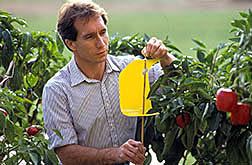
Midspring comes to the Deep South and a vegetable grower hopes for bumper crops of bell and jalapeno peppers. But a crop consultant hired for troubleshooting examines a fallen pepper, cuts into it, and finds a pepper weevil larva.
Just one Anthonomus eugenii larva among 100 peppers could be a harbinger of serious yield losses later in the season. For pepper weevils—like their boll weevil cousins on cotton—multiply rapidly; with life cycles of about 3 weeks, generations eventually overlap.
The consultant knows that unless something is done soon, more and more damaged peppers will begin to fall to the ground and rot. Lightly infested ones will be unmarketable. Who wants a weevil in a salad?
Enter the spray rigs. Though larvae munching inside the peppers won't likely be stopped, spraying insecticide about once a week could kill the overlapping generations of adult female weevils flying about.
But such frequent insecticide applications through the months-long harvest season impede natural control of other pests. They also complicate the harvest because of the waiting periods required between each spraying and picking before workers can re-enter fields.
Juan R. Anciso, a Texas Agricultural Extension Service entomologist at Edinburg, says pepper weevils often aren't discovered and sprayed soon enough to save a crop. Last spring, in the lower Rio Grande Valley, some pepper fields were plowed under unharvested, he says, losing growers hundreds of thousands of dollars.
The weevils destroy all types of peppers in southern-tier states and throughout Mexico and Central America. Economic losses in the United States are estimated at $23 million per year.
Now ARS scientists have taken the initiative in helping integrated pest management (IPM) come front and center to the weevil war.
A new, commercially available insect trapping system detects pepper weevils usually 2 or 3 weeks before field scouts find either the adult weevils around plants or larvae in fruiting peppers.
"Developing an attractant/trap system that could reduce the need for insecticides by defining when and if applications were needed—that was our goal," says Robert J. Bartelt, an ARS entomologist at the National Center for Agricultural Utilization Research (NCAUR) in Peoria, Illinois.
Anciso says each spraying that can be avoided often saves the grower about $15 per acre in insecticide costs alone.
Seeking the Come-Hither Pheromone
Responding to the need for a synthetic attractant, entomologists Bartelt and Fred J. Eller began research in 1990 to identify volatile chemicals produced by the weevil.
They took the 1/8-inch-long adult weevils from their laboratory colony and anesthetized them with carbon dioxide to determine the sex of each.
Then they collected and chemically analyzed the volatiles produced when single weevils fed on jalapeno peppers.
By 1993, the scientists applied for a patent on a combination of six chemicals that mimicked the pheromone released by male pepper weevils. Three of the six commercially available chemicals were already being used as part of the synthetic boll weevil pheromone.
The chemical mix—an aggregation pheromone—is a signal to both female and male weevils that a good source of food is nearby and other weevils are already present. Field tests in Texas, California, Florida, New Mexico, and Mexico proved that the pheromone in sticky traps had potential as a weevil population monitoring tool.
The time was ripe for private industry to become involved in further development of the pheromone for practical field use. ARS formed a cooperative research and development agreement (CRADA) with Trece, Inc., of Salinas, California, to determine the best component blend, dose, pheromone dispenser, and trap design to use in commercial pepper fields.
As with four previous CRADA's, Trece teamed up with ARS entomologists and chemists to try refining the invention into user-friendly and commercially successful forms, combining expertise in engineering, manufacturing, and marketing.
"We had found the CRADA program to be really successful, and we saw an opportunity to serve the pepper-growing industry," said Bill Lingren, company president.
Though the pepper industry is small, it is one of the fastest growing, as peppers are being used in many processed foods.
In mid-1994, as research continued on improving formulations for sticky traps, the company reported sales had been brisk for its first Pherocon pepper weevil trap, available to growers through agricultural supply firms.
The ARS technology, patented in late 1994, was licensed to Trece on an exclusive basis.
"Experience we're gaining from pepper weevil research may someday prove useful for IPM of related Anthonomus pests, including cranberry weevil, strawberry bud weevil, and apple curculio," says Eller, who is now in the NCAUR's Food Quality and Safety Research Unit.
If presently used insecticides become no longer commercially available because of regulatory bans or because target pests become resistant to insecticides, IPM that includes monitoring traps could take on greater importance.
Each pepper weevil trap, containing only 10 milligrams of synthetic chemicals, is designed to release about 10 millionths of a gram per hour and to monitor up to a hectare, which is about 2.5 acres.
Other IPM-oriented pepper weevil research is being conducted by ARS entomologist Donald A. Nordlund in Weslaco, Texas. He says at least seven parasites attack the pest, including Catolaccus hunteri, a cousin of the C. grandis that feeds on boll weevils. [See "Evicting the Boll Weevil," Agricultural Research, March 1994, pp. 4-10.]
If an artificial diet for C. hunteri or some other parasite can be developed, it may be possible to mass-rear and release them so they can prevent the usual buildup of pepper weevils as the season progresses. This control approach is known as augmentation.
Alternatively, mass releases of the parasites after pepper crops have been harvested may suppress weevil populations in wild plant hosts, such as nightshades, before the next growing season.
Feasibility studies on mass release of parasites to control pepper weevils may encourage commercial parasite rearing. Nordlund notes that production of natural enemies of pest insects is an expanding industry.
While pepper growers look forward to new biological control technology, keeping a close watch on weevil populations so as to make insecticide applications more efficient is the most environmentally friendly development so far, says Eller. -- By Ben Hardin, ARS.
Robert J. Bartelt is in the USDA-ARS Crop Bioprotection Research Unit, and Fred J. Eller is in the Food Quality and Safety Research Unit, National Center for Agricultural Utilization Research, 1815 N. University Street, Peoria, IL 61604; phone (309) 681-6541.
"Pepper Weevils: New Trap Aids IPM" was published in the April 1995 issue of Agricultural Research magazine.
