
United States Department of Agriculture
AgResearch Magazine


Microbes Clean Up Cattle Dip
|
|
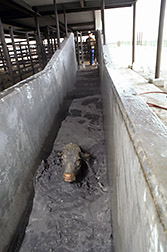
A million Mexican cattle a year scramble into the United States through concrete vats placed on the Mexican side of major border crossings.
The vats—more like concrete chutes—each hold 5,000 gallons of tick-killing coumaphos and water. The cattle jump into dip that is over their heads and then swim a little before the ramp bottom rises enough to allow them to walk out the other end.
The dip in each vat has to be changed at least every 2 years and in many cases more often. So what do you do with 100,000 gallons of used pesticide dip generated every year?
Jeffrey S. Karns, an ARS microbiologist in Beltsville, Maryland, found that the coumaphos insecticide in waste dip can be converted to carbon dioxide and water, with a little encouragement to some microbes that live in the dip.
By adding iron and magnesium salts and other nutrients to function like vitamins for these microbes and by carefully adjusting the dip's acidity and oxygen content, Karns has gotten the microbes to oxidize unwanted components in just a week or two.
The technique works just as well on soil contaminated by dip disposal, says Karns.
Karns works on the project with ARS microbiologists Walter W. Mulbry and Daniel R. Shelton, who are also at Beltsville.
So why is all this dipping being done? In addition to the tick-prevention measures at the border, American ranchers use 42 vats scattered along the U.S. side of the border to treat cattle whenever a tick outbreak occurs. These outbreaks are often due to infested deer or cows wading across the Rio Grande.
Since 1935, USDA tick eradication program officials have been supervising the operation of vats on both sides of the Texas-Mexico border in a 500-mile-long strip of land along it. This quarantine zone is the only part of the United States where cattle fever ticks are found.
It is also a zone of constant vigilance: Cattle are not allowed to leave without treatment. That keeps ticks from entering the United States from Mexico, where the tick remains prevalent—despite some 3,000 vats for Mexican ranchers' use.
USDA's Animal and Plant Health Inspection Service oversees the tick eradication program, in cooperation with the state of Texas. Entomologists Elmer H. Ahrens and Ronald B. Davey, who are at the ARS Cattle Fever Tick Research Laboratory in Mission, Texas, send samples from the vats to Beltsville for analysis.
The dipping is necessary to prevent the reintroduction of cattle fever to the United States. Cattle fever once nearly destroyed the southern cattle industry because few northerners wanted to risk buying tick-infested cattle. It cost the cattle industry over $1 billion a year in losses and reduced production before the tick's eradication outside of the quarantine zone, in 1943. -- By Don Comis, ARS.
Daniel R. Shelton is at the USDA-ARS Environmental Microbial Safety Laboratory, Bldg. 007, 10300 Baltimore Ave., Beltsville, MD 20705; phone (301) 504-6582, fax (301) 504-6608.
Jeffrey S. Karns is at the USDA-ARS Environmental Microbial Safety Laboratory and Walter W. Mulbry is at the ARS Animal Manure & By-Products Laboratory, 10300 Baltimore Ave., Beltsville, MD 20705.
"Microbes Clean Up Cattle Dip" was published in the April 1995 issue of Agricultural Research magazine.
