
United States Department of Agriculture
AgResearch Magazine


FACE-ing the Future
It's the largest experiment ever to measure CO2 effect.
|
|
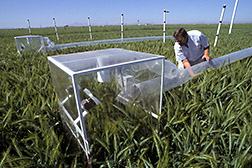
At the U.S. Water Conservation Laboratory in Phoenix, Arizona, the future is now!
To see how crops will grow when carbon dioxide becomes more prevalent in our atmosphere, ARS scientists there are pumping large quantities of CO2 across large, open-air test plots.
And while the gas bill for this—the world's largest such experiment—reaches close to $100,000 annually, the money is well spent. For like a factory, the experiment's large size produces an economy of scale. Per dollar, the Free Air Carbon Dioxide Enrichment project—FACE—produces 4 to 10 times as many high-CO2-grown plants needed for research as other methods.
'Today's air contains about 360 parts per million of CO2. That's up from levels of 265 in pro-industrial times and 315 as recently as 1958," says soil scientist Bruce A. Kimball. "Because there's every reason to believe this trend will continue, we are conducting scientific studies that will prepare us for the change."
Head of the ARS Environmental and Plant Dynamics Research Unit, Kimball leads a team that is subjecting crops to environmental conditions like those expected in the next century, especially air with a doubled CO2 level.
"There's no reason to panic, because humans will not be directly affected," Kimball says. "The air we breathe contains 78 percent nitrogen and 21 percent oxygen; the remaining 1 percent is a mixture of CO2, argon, neon, and helium. However, growth patterns of all major food crops will change, and we need to find out exactly how."
Carbon dioxide affects both the process of photosynthesis and plant leaf resistance to water vapor loss.
This large ARS study simulates field conditions representing those anticipated in the next 50 to 75 years. Large amounts of CO2 are released through upright pipes that maintain a constant 550 parts per million in the air around plants in open fields. Previous experiments were in open-top chambers whose walls affected plant growth and distorted findings. Other experiments in greenhouses or growth chambers also produced data that were not representative of natural, outdoor conditions.
Last year, there were 50 scientists from 25 different locations in eight countries—Canada, Germany, Italy, Japan, Spain, The Netherlands, United Kingdom, and the United States—collecting or analyzing data from the large plots located at the University of Arizona's Maricopa Agricultural Center.
And the ARS scientists based at Phoenix will make the data available to all researchers who can tap into the Internet.
Two crops have been extensively studied: cotton and wheat. Smaller subplots include corn, sorghum, sudangrass, and barley.
Facing Up to Future Change
|
|
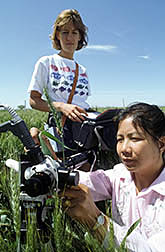
"FACE has already contributed a lot to understanding how elevated CO2 will increase plant growth—especially, of plants we rely on for food and fiber," says Kimball. "We are also getting basic information on how individual factors such as carbon cycling and water vapor pressure interact to produce that increase. This will help us predict our future climate and water resources under a higher CO2 environment."
The data show that relative growth responses to CO2 are similar in both FACE plots and open-top chambers. But only the FACE approach produces data that can be relied on to represent future field conditions.
"One of the more interesting findings to come from our study is that soil in our FACE experiments stored more carbon, compared to regular fields. The cotton study indicated that soil carbon increased more than 10 percent in only 3 years.
This observation may help clear up a mystery that puzzles modelers of global carbon volume. Only about half of the carbon emissions from burning fossil fuels can be accounted for in the atmosphere, and their models do not explain where all the carbon is relocating.
"We hope our data will help them solve the missing carbon question," says Kimball.
Information on the effects of increased CO2 will be important to other researchers who are looking at the larger picture of global change. Increased CO2 is only one component. Other changes include increased temperatures and altered moisture distribution patterns.
The Bottom Line
Scientists summarize their results by saying elevated CO2 levels are generally good for most plants. They produce more yield and use less water. But increased amounts of the gas affect different plant species in different ways.
Cotton, a woody summer crop, was highly responsive to the elevated CO2. It yielded up to 50 percent more at 360 ppm, under well-irrigated field conditions, and about 43 percent more under dry conditions.
In contrast, wheat, a cool-season grass, increased its growth about 20 percent at midseason under both wet and dry conditions. But the elevated CO2 caused the wheat to mature sooner, thereby shortening the growing season and giving a final yield only 8 percent higher in the wet plots.
Root growth increased about 50 percent in wheat, with most occurring in midsize roots. Cotton taproots were from 40 to 70 percent larger.
Microbial populations varied, but total activity as measured by respiration was up. So, not only was more carbon stored in the soil, more carbon was also respired in the soil and returned to the atmosphere.
Cotton leaves grown under elevated CO2 levels experienced large increases in leaf starch, while wheat leaves had large increases in both sugars and starch.
|
|

Consistent with the increases in leaf starches and sugars, there was a slight decrease in nitrogen concentration in FACE-grown wheat and significantly less in cotton.
This implies that the leaves of plants in the future will provide less protein per pound for cattle and leaf-eating insects.
Digestibility of sudangrass and wheat was not changed. There had been some speculation that digestibility would decrease because cell walls are usually thicker under FACE.
Canopy temperatures of cotton were an average 0.8 degrees warmer under FACE. Wheat plants were 0.56 degrees warmer. In the case of the wheat, such an increase in plant temperature probably contributed to the earlier maturity of the FACE-grown plants.
Leaf photosynthesis increased between 20 and 40 percent in FACE cotton plants. Photosynthesis increased about 20 percent in irrigated wheat and about 75 percent in dryland wheat. Although not the full story, these increases in photosynthesis are undoubtedly responsible for the eventual increases in plant growth, says Kimball.
Plants used water more efficiently. Cotton and wheat yielded 50 percent product per unit of water used. While CO2 had little effect on cotton's water, wheat used 11 percent less per acre, according to energy flow measurements.
The cotton data arc now being used to validate a computer program called COTCO2, a cotton growth simulation model. Researchers plan to use it to predict how increased atmospheric CO2 and any associated climate change will affect cotton growth and water use in the future.
|
|
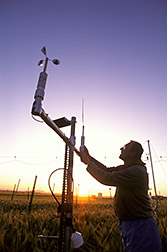
Other computer modelers should find the program valuable, too. For example, the wheat data are being used to validate wheat growth models developed by several cooperators.
In addition to the U.S. Water Conservation Laboratory, other ARS laboratories working on FACE include the Western Cotton Research Laboratory in Phoenix, as well as labs in Temple, Texas; Athens, Georgia; Pullman, Washington; Gainesville, Florida; Riverside, California; Auburn, Alabama; and Fort Collins, Colorado.
The FACE project was started cooperatively by ARS, along with the U.S. Department of Energy and its Brookhaven National Laboratory in Upton, New York, and by Tuskegee University in Tuskegee, Alabama.
For the next 2 years, the FACE project will examine the interactive effects of CO2 and soil nitrogen supply on wheat growth and carbon exchange, especially on soil carbon sequestering and exchange. The project will he funded by a grant from the U.S. Department of Energy to the University of Arizona, but ARS scientists will continue to be major collaborators and will assist in the management of the project. -- By Dennis Senft, ARS.
Bruce A. Kimball is in the USDA-ARS U.S. Water Conservation Laboratory, 4331 E. Broadway Rd., Phoenix, AZ 85040; phone (602) 437-1702, fax (602) 437-5291.
Less Thirst—More Growth!
It's probably no surprise that the Western range's famed "wide open spaces" aren't as wide open as they once were. But one factor behind the change might surprise you: Range plants may not be as thirsty as they used to be.
The reason is carbon dioxide—CO2—which is used by plants for growth.
Plants take in CO2 from the atmosphere through tiny openings in their leaves. When these openings, called stomates, are gaping to gulp in CO2, precious water inside the plant escapes through the same openings. So the plant must take in greater amounts of water from the soil to maintain enough to survive.
|
|
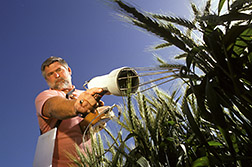
Current atmospheric CO2 levels are about 360 parts per million (ppm), compared with 280 ppm a century ago—a gain attributed in part to burning of fossil fuels and changes in land use. The greater abundance of atmospheric CO2 means plant stomates don't have to open as wide to take in sufficient carbon dioxide. That, in turn, means less water is used by the plant, says ARS ecologist Hyrum B. Johnson.
"We know from photographs and other records that there is more brush on the range today than a century ago," Johnson points out. "Rising CO2 levels may have enabled plants to proliferate on parts of the range that were formerly too dry, because the plants now use water more efficiently."
At the ARS Grassland, Soil, and Water Research Laboratory at Temple, Texas, Johnson and fellow ARS scientists Herman S. Mayeux and H. Wayne Polley have experimented since 1988 with growing various plants in different CO2 levels. They range from today's 360 ppm back to the about 180 ppm of the last Ice Age 15,000 years ago and forward to the anticipated 700 to 1,000 ppm of the future.
"We planted seeds of a rangeland brush species called acacia in large soil boxes in August 1992," explains Mayeux. "We kept the boxes in greenhouse bays maintained at different CO2 levels—350 ppm, 700 ppm, or 1,000 ppm. We found that the plants in the higher CO2 grew much faster, although they used about the same amount of water as those growing in 350 ppm."
Between August and December 1992, stems on the acacia in 1,000 ppm of CO2 grew an average of 23 feet, compared with an average of about 15 feet for the plants in 700 ppm and about 5 feet for plants in 350 ppm.
In a related project, Johnson, Mayeux, and Policy grew two varieties of wheat in a specially constructed growth chamber in which flowing air's CO2 content gradually declined from 350 ppm to 200 ppm at various locations within the chamber. The wheat varieties were Yaqui 54, a variety typical of the wheats grown in the 1950's, and Seri M82, representative of varieties grown now.
"In 200 ppm CO2, the plants did very poorly and required twice as much water to grow the same amount of forage or grain," reports Polley. "As CO2 increased to modern levels, seed yield tripled for both varieties. The size of the individual grains didn't change, but there were more individual grains per spike."
"In the past 150 years, CO2 levels have risen 30 percent, and the rate of increase has been most rapid in recent decades," Mayeux adds. "In today's agricultural production, we may already be experiencing an impact from higher CO2 levels." -- By Sandy Miller Hays, ARS.
Hyrum B. Johnson, Herman S. Mayeux, and H. Wayne Polley are in the USDA- ARS Grassland, Soil, and Water Research Laboratory, 808 East Blackland Road, Temple, TX 76502; phone (254) 770-6501, fax (254) 770-6561.
"FACE-ing the Future" was published in the April 1995 issue of Agricultural Research magazine.
