
United States Department of Agriculture
AgResearch Magazine


ARS Collaborates in Regional Dairy Quality Management Alliance
|
|
Microbial pathogens have long been a concern in dairy production because of their effects on animal health, milk production, and economics.
In 2003, the Agricultural Research Service entered a partnership with the Regional Dairy Quality Management Alliance to help validate best management practices (BMPs) that minimize disease risk and ensure maximum safety of products leaving the farm.
Food safety issues are increasingly prominent in the United States. Thanks to pasteurization, the risk to consumers of pathogens in milk is very low. But improper handling of milk and milk products can result in bacterial growth and substantially increase potential risk to consumers. And there are people who prefer to consume raw (unpasteurized) milk or raw-milk products.
In 2002, stakeholders in 10 Northeast and Mid-Atlantic states formed the alliance. Their mission is to ensure a healthy and safe food supply, promote animal health and welfare, improve productivity and profitability, and encourage environmental stewardship.
The following year, alliance participants and ARS researchers decided to evaluate current BMPs and develop new, more effective ones. The collaborative team consists of ARS's Environmental Microbial Safety Laboratory (EMSL) in Beltsville, Maryland; ARS's Antimicrobial Research Laboratory in Athens, Georgia; Cornell University; Pennsylvania State University; and the University of Pennsylvania (UP).
A pilot project, begun in January 2004, consisted of two dairy herds—a 300-cow herd in New York and a 100-cow herd in Pennsylvania. A third herd in Vermont was recently added.
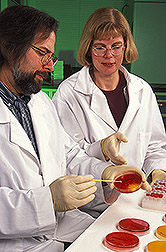
"These herds were selected on criteria including known Johne's disease prevalence or Salmonella positive status, Dairy Herd Improvement Association membership with monthly testing, and on-farm disease recording," says Jo Ann Van Kessel, an EMSL researcher.
Data collection is the main activity at this time. "We collect biological samples—like blood, manure, and bulk tank milk—and environmental samples, such as bird droppings, water, feed, and soil," says Van Kessel.
The biological samples are distributed to university and ARS researchers, who test them for the presence of Mycobacterium avium subspecies paratuberculosis—the bacterium that causes Johne's disease—Salmonella, E. coli O157:H7, Listeria monocytogenes, and Campylobacter. The samples are also stored at UP's New Bolton Center biobank to aid future research.
"In one sampling on one of the test farms, we found that although 45 percent of the cows tested positive for Salmonella, no Salmonella was actually detected in the bulk tank milk," says ARS microbiologist Jeffrey Karns. "We're using molecular genetic techniques to detect particular strains of Salmonella, Listeria, and E. coli. This helps differentiate those that are harmful to humans from those that are not."
"We'll use the collected data to determine the location of pathogens on the farms, how they are getting there, how long they survive, and how they get into milk," says Van Kessel. "We can then look at the BMPs to determine which ones will truly benefit the dairy farmer."—By Sharon Durham, Agricultural Research Service Information Staff.
This research is part of Food Safety, an ARS National Program (#108) described on the World Wide Web at www.nps.ars.usda.gov.
Jo Ann Van Kessel and Jeffrey Karns are with the USDA-ARS Environmental Microbial Safety Laboratory, 10300 Baltimore Ave., Bldg. 173, Room 201, Beltsville, MD 20705-2350; phone (301) 504-8287, fax (301) 504-6608.
"ARS Collaborates in Regional Dairy Quality Management Alliance" was published in the April 2005 issue of Agricultural Research magazine.
