United States Department of Agriculture
AgResearch Magazine


Cotton Carpeting That Fights Off Flames |
|
|
|
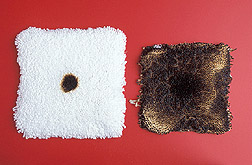
Cotton truly is king—when it comes to soft, comfortable clothing that breathes. Now, ARS research chemists Eugene Blanchard and Elena Graves are working to extend cotton's reign from clothing to rugs and carpets, a $10 billion market in which nylon, polyester, and other synthetic fibers dominate. Cotton's pauper status with floor coverings has to do with its burning characteristics, which often prevent it from meeting a federally mandated standard for surface flammability. The standard is derived from the methenamine pill test, in which a 9- by 9-inch steel frame with an 8-inch-diameter hole is placed over a 12- by 12-inch carpet sample. A methenamine pill is placed in the center and ignited. "What happens to cotton in some floor-covering materials with a low density of loops or cut pile is that the flame spreads during combustion until the whole surface becomes charred," says Blanchard, who is in ARS' Cotton Textile Chemistry Unit, New Orleans, Louisiana. But to pass the pill test, the charred area must not extend to within 1 inch of the hole's edge at any point for at least seven of eight samples. "In most cases, cotton-containing floor covering with a low-density cut-pile surface won't pass this test," says Blanchard. "What we've done is to treat the material's cotton component with certain chemicals so that the flame doesn't spread more than 1 inch from the ignition source. Technically, it could spread over a 3-inch radius in all directions and still pass the test." Several flame-retardant agents are commercially available. But many aren't cost effective for practical application to all-cotton or cotton/polyester carpeting. What's more, some contain formaldehyde, which gives off a colorless, pungent gas that can harm health in some individuals. Because of this, says Blanchard, "cotton is at a disadvantage against synthetic fiber materials." His search for safer, more economical alternatives began in April 1999 in collaboration with William A. Rearick, director of textile chemistry research at Cotton Incorporated, Cary, North Carolina. Through earlier ARS research on a cross-linking process for creating permanent-press fabrics, Blanchard was able to impart flame-resistant properties to cotton carpeting by treating it with nontoxic chemicals called polycarboxylic acids. Citric acid, maleic acid, and butanetetracarboxylic acid are the three agents used most often. Each was chosen because of an ability to react with cotton fibers, low cost, relative abundance, and absence of formaldehyde. Since floor covering is involved, "you want to use agents that aren't harmful to humans or domestic animals," Blanchard says. The process also involves using sodium carbonate or sodium bicarbonate either alone or in combination with a phosphorus-based catalyst. This step neutralizes the formulation's pH to levels of 3.5 to 4.5 and thus prevents shade-change problems on dyed material. Once treated, the material is dried and then heat cured to fix the chemical agents. After undergoing 10 wash cycles with detergent, the samples are again dried in preparation for the methenamine pill test. Blanchard and Graves fully described the process in the January 2002 issue of Textile Research Journal. Use of this technology could help U.S. cotton capture a greater share of the carpeting market, which consumes 5 million bales of synthetic fiber annually, according to estimates by Cotton Incorporated. By Blanchard's reckoning, "the cut-pile carpeting market is probably the way to go for this type of cotton product. But for the future," he adds, "we're also looking at the fleece fabric market, in which there is restricted use of 100-percent cotton."—By Jan Suszkiw, Agricultural Research Service Information Staff. This research is part of Quality and Utilization of Agricultural Products, an ARS National Program (#306) described on the World Wide Web at http://www.nps.ars.usda.gov. Eugene J. Blanchard and Elena Graves are in the USDA-ARS Cotton Textile Chemistry Unit, Southern Regional Research Center, 1100 Robert E. Lee Blvd., New Orleans, LA 70124; phone (504) 286-4495, fax (504) 286-4419.
|
| "Cotton Carpeting That Fights Off Flames" was published in the April 2002 issue of Agricultural Research magazine. |